
Your AI strategy is probably wrong — Why multi-agent AI Ecommerce is what actually moves the needle

I've sat through 30+ AI vendor demos for DTC brands in the last 18 months. Every single one follows the same script.
An affable sales engineer types a question into a chat widget:
- "What size is this dress?"
- Three seconds later, an LLM generates an answer pulled from a product feed.
- Everyone nods. Someone says "game-changer."
Here's what nobody tells you: that demo is a magic trick, It works on a clean laptop with five products in the catalog and a prompt written the night before.
In production — with 50,000 SKUs, real-time inventory, pricing conflicts, and a customer who's been abandoned-carted four times this week — that same chatbot is just a friendly FAQ machine.
It costs you $3,000 to $8,000 a month in API fees.
And it doesn't close a single sale.
The $5,000 FAQ Machine
Let me be blunt. Most "AI" deployments in DTC right now are RAG chatbots.
Retrieval Augmented Generation — a fancy way of saying "your knowledge base with a language model taped to the front."
The customer asks a question, the system searches for similar text, the LLM rewrites it into a polite answer.
This has value.
It deflects support tickets.
Customers get answers at 3 AM. Good.
But here's the problem: brands are paying for this and expecting it to drive revenue, they see "AI" on the invoice and assume it's optimizing their conversion funnel. It's not. It's answering questions.
I looked at the numbers for a DTC fashion brand pulling $4.2M/month in GMV.
Their "AI" stack:
| Item | Monthly Cost |
|---|---|
| Chatbot platform (enterprise tier) | $2,400 |
| GPT-4 API for response generation | $1,800 |
| Custom embeddings + vector DB | $600 |
| Analytics/reporting add-on | $400 |
| Total | $5,200 |
Conversion rate attributed to the chatbot: 0.3% – that's roughly $12,600 in attributed revenue.
Against $5,200 in direct costs.
Net gain: $7,400.
Now look at their total tech spend — $5,200/month for what is essentially an FAQ machine that generates $7,400 in lift.
But here's the thing: that $5,200/month could fund a multi-agent system that generated $47,000 in incremental revenue in 60 days for a brand half their size. (More on that later.)
The difference isn't the model, the difference is the architecture.
Why bigger models won't save you
The AI industry has a reflex when something doesn't work: ship a bigger model
Why bigger models won't save you
Chatbot underperforming? Upgrade to GPT-5.X.
Still not converting? Fine-tune it on your data.
Still not great? Switch provider to Claude Opus, Fable — that'll fix it.
No. It won't.
A single model — no matter how good — has a fundamental limitation when you point it at ecommerce, It's trying to optimize for the wrong thing.
It's trying to optimize for answer quality, they want to generate text that sounds good, is accurate, and pleases the user.
Ecommerce conversion optimizes for decision quality
Examples:
– "Should this customer get 12% off or 18%?
– "Should we ship from Berlin or Frankfurt?"
– "Should we show the trench coat or the puffer first?"
These aren't language tasks, they're allocation problems and a single model — even a very smart one — CAN make good allocation decisions in isolation.
Show it one customer, one product, one scenario, and it'll generate a reasonable answer but the problem emerges at scale, without proper context.
When the model has to balance margin against conversion, inventory depth against shipping speed, and personalization against privacy — all while generating fluent text — something has to give.
And what gives is the thing the model wasn't fine-tuned for: your bottom line.
I've seen it happen in production a brand fine-tuned GPT-5.5 on 18 months of customer service transcripts and purchase data, the model got very good at sounding like their brand voice.
It was warm, witty, on-brand – It also started offering 30% discounts to customers who simply asked for them, because the training data contained instances where aggressive discounts closed a sale.
The company bled margin for six weeks before someone noticed.
The model wasn't malicious. It was optimizing for the wrong objective.
The Agentic Gap Framework
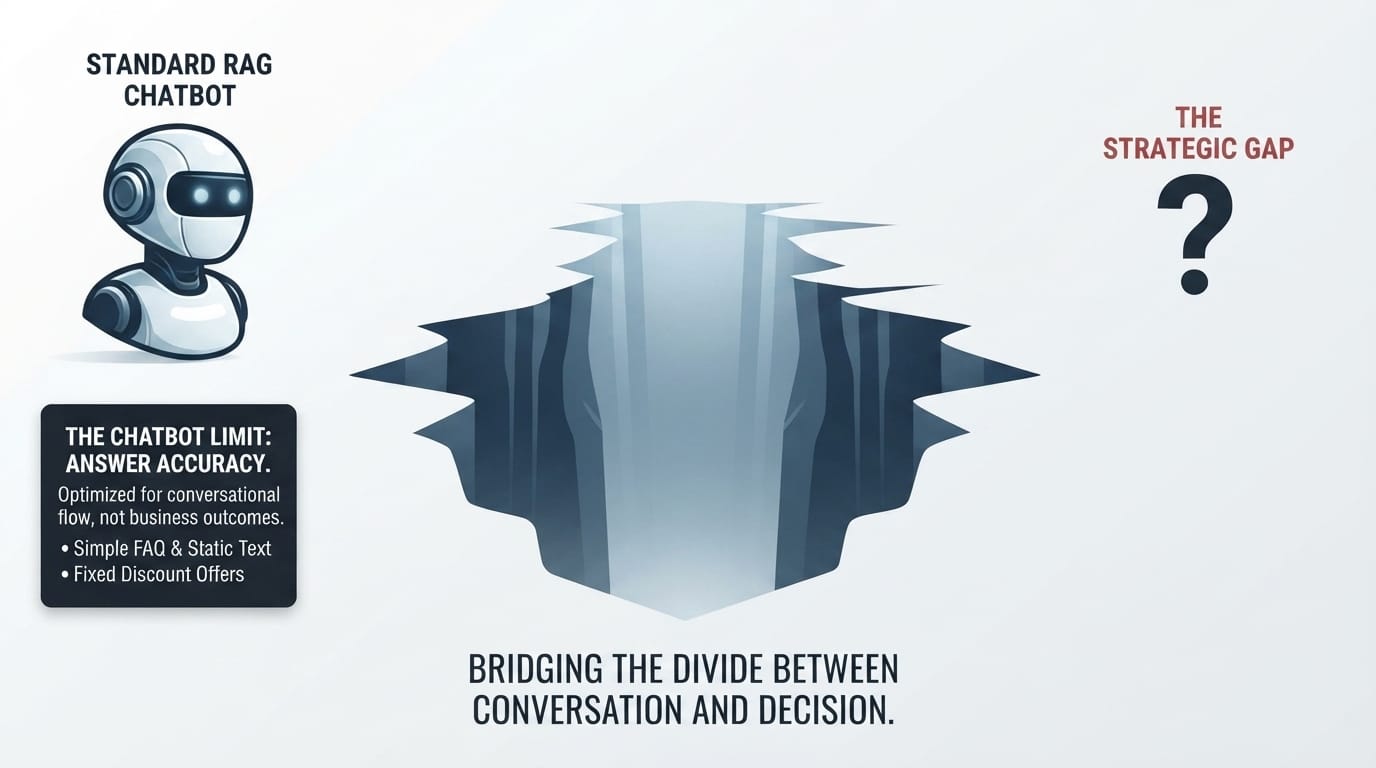
Here's a framework I've been using to diagnose failing ecommerce AI initiatives. I call it the Agentic Gap.
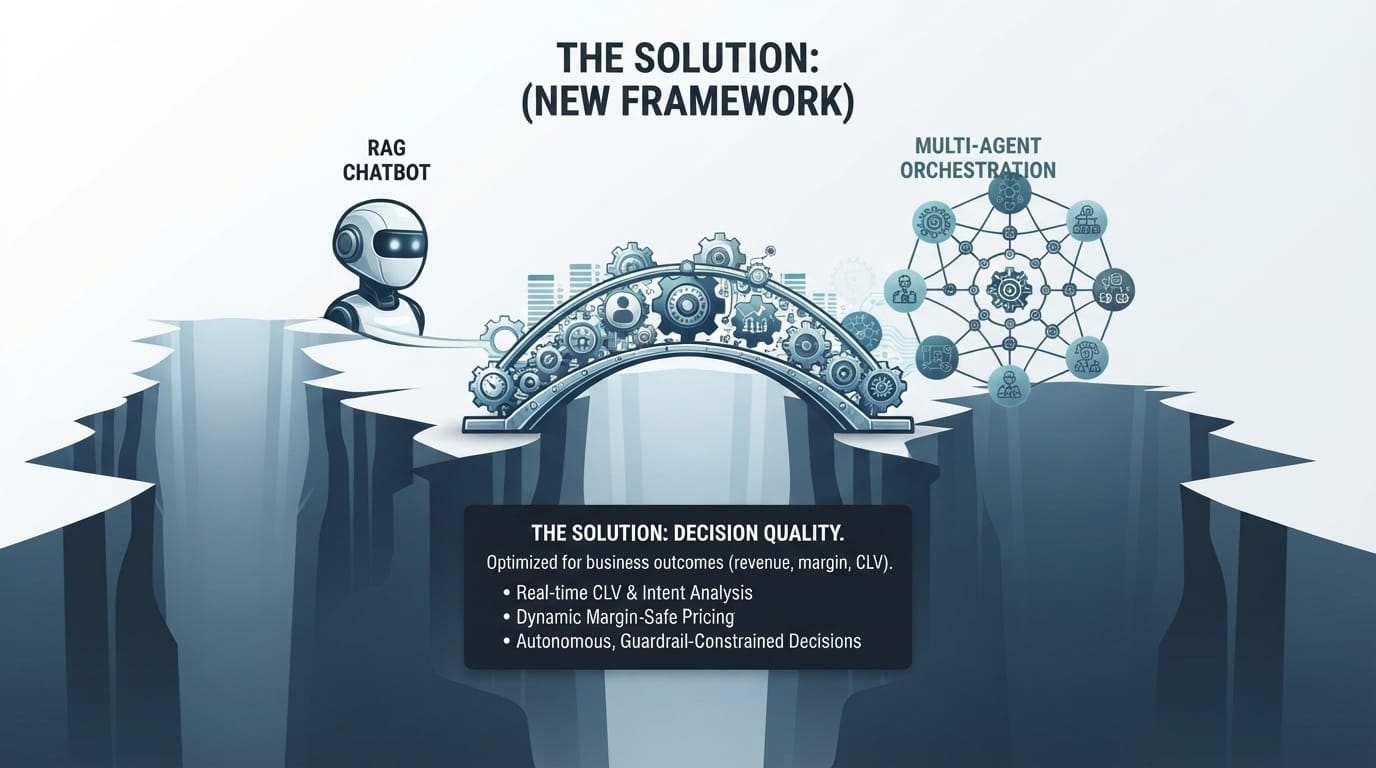
The gap is the structural chasm between language processing (what LLMs are naturally built to do) and decision orchestration (what businesses actually require to drive profit).
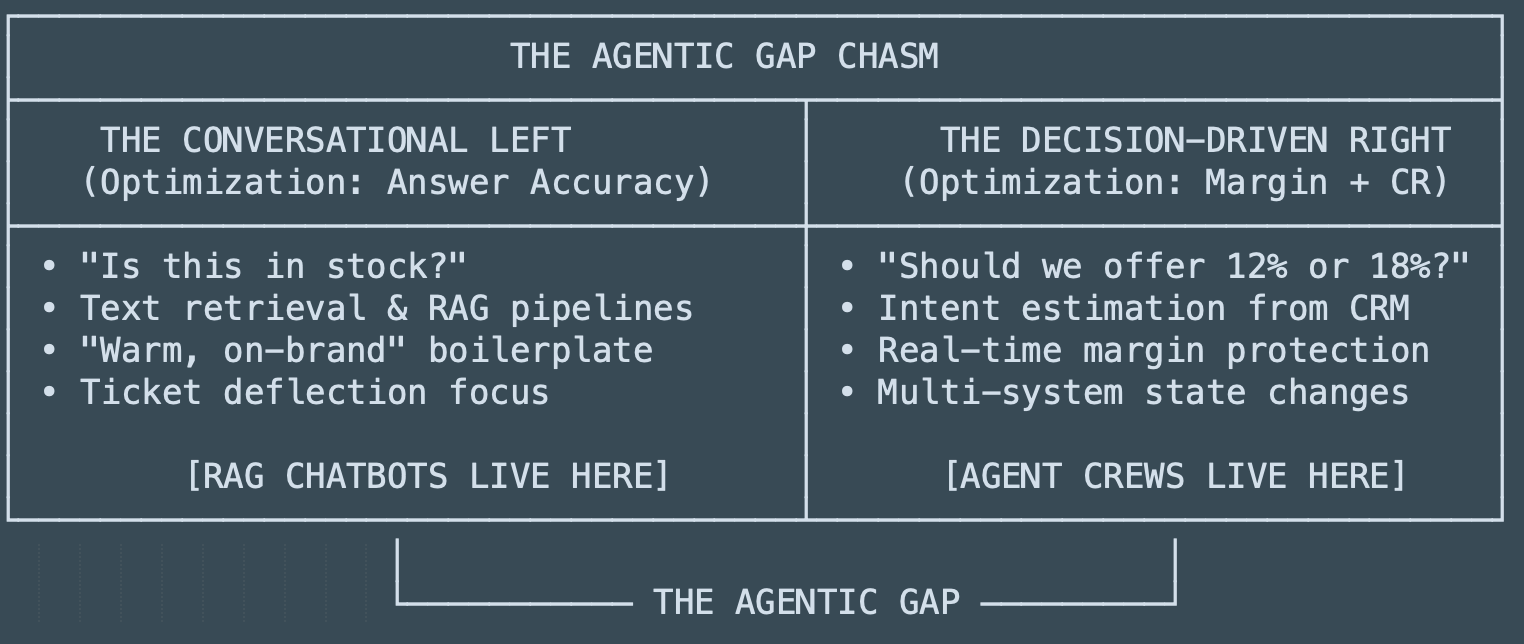
To understand this in production, compare how a single-model chatbot and a multi-agent system handle the exact same high-intent customer query.
The Litmus test: "Do you have the linen dress in blue, and can I get it by Friday?"
The Conversational Chatbot:
- Queries the Shopify database via basic vector search.
- Finds the product, verifies "blue" is in stock.
- Generates a beautiful, highly polite response: "Yes! We have the linen dress in blue. Standard shipping takes 3-5 business days, so it might arrive by Friday if you order today. Click here to buy!"
- Outcome: The user, unwilling to gamble on "might arrive," closes the tab. The bot logs a 100% "accurate" response. Your conversion is 0%.
The Decision-Driven Crew:
- Inventory Agent verifies blue is in stock.
- Logistics Agent checks the customer's ZIP code against warehouse locations, calculates real-time 2-day transit times, and identifies that only Frankfurt has express slots left.
- Profile Agent pulls CRM data: this is a VIP tier customer (CLV: $850) who hasn't purchased in 90 days.
- Pricing Agent runs the numbers: margin on the dress is 68%. The express shipping surcharge is $15.
- Orchestrator Agent reconciles: Do not offer a discount. Instead, waive the $15 express shipping fee to guarantee Friday delivery.
- System response: "Yes, we have it. I've reserved a blue one in your size at our Frankfurt facility. If you complete checkout in the next 14 minutes, I will upgrade you to Guaranteed Friday Delivery for free (saving you $15)."
- Outcome: Checkout completed. AOV increases. Scarcity and personalized value close the loop.
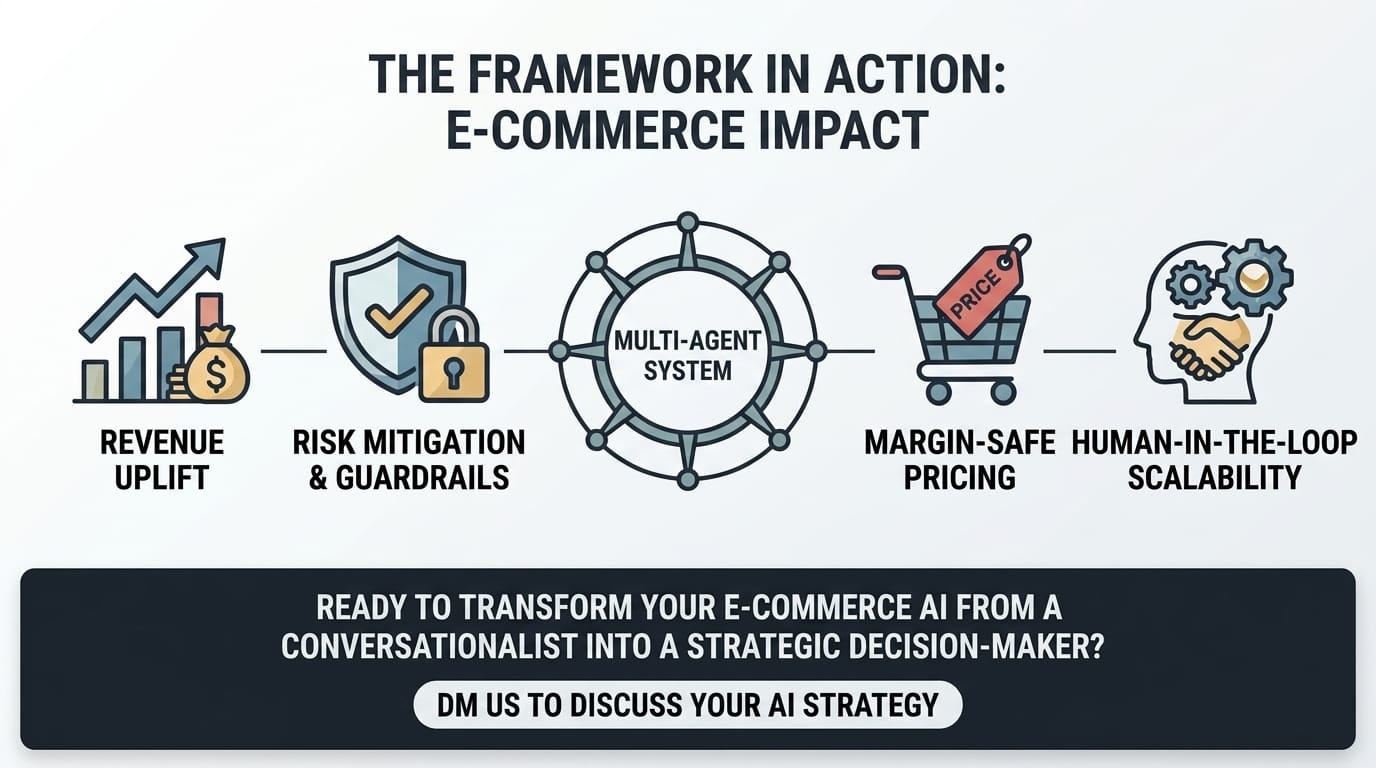
The difference in revenue isn't a better linguistic model. It is the ability to orchestrate cross-functional trade-offs in real time.
Measuring your technical waste
Measuring the Agentic Gap Ratio
Most DTC brands are drowning in conversational noise, to quantify this, I use a metric I call the Agentic Ratio (AR).
It measures the density of actual business decisions relative to the amount of conversational boilerplate you are paying for in API tokens.
Note: A "Policy Decision" is defined as any automated state change that impacts inventory, pricing, routing, or segment assignment, a simple answer a product question does not count.
- Standard FAQ RAG Chatbot: generates 45,000 tokens of polite prose across a hundred conversations. Makes exactly 0 policy decisions. AR = 0.0. You are paying for language, not business outcomes.
- Production-Grade Multi-Agent Crew: generates 8,000 highly targeted tokens. Makes 24 distinct policy decisions (discounts locked, stock reserved, custom delivery promises made). AR = 3.0.
The Agentic Gap is the distance between an AR of 0.0 and an AR of 3.0.
Most brands are investing six figures in the former while wondering why their bottom line doesn't budge.
Bridging this gap doesn't require fine-tuning a larger foundation model on more transcripts, It requires modularity — separating the language interface from the operational logic.
You don't need a smarter brain. You need a smarter system.
Where the Money Actually Goes
Let me give you a more honest cost breakdown, not the "API pricing" story vendors tell you, the real one.
Before multi-agent (what most brands do):
- Chatbot platform: $2,000–$5,000/mo
- LLM API for the chatbot: $1,000–$3,000/mo
- Abandoned cart tool (Klaviyo, etc.): $300–$800/mo
- Personalization engine (Nosto, Dynamic Yield): $1,500–$4,000/mo
- Retargeting (Meta/Google automated): $3,000–$10,000/mo in ad spend
- Total tools: $7,800–$22,800/mo
Each tool has its own AI, none of them talk to each other, the chatbot doesn't know the personalization engine's recommendations.
The retargeting system doesn't check inventory.
The abandoned cart tool sends the same email to a $50K customer and a first-time visitor.
And here's the killer:
Each tool's AI improves independently, but the system doesn't improve at all. You're paying for six separate optimizations that actively conflict with each other.
After multi-agent (what a few brands are doing):
- LLM API (shared across agents): $1,200/mo
- Infrastructure (hosting, cache, monitoring): $380/mo
- No separate chatbot, personalization, or abandoned cart tools — the orchestration layer replaces them
- Total: $1,580/mo
But here's the number that matters: the multi-agent system for a home goods retailer (public case study, I didn't run this one) lifted conversion from 2.1% to 3.7% — incremental GMV of $47,000/month on a $1,580/month cost. That's not a 3x ROI. That's a 29.7x ROI.
The before-and-after on tool spend is almost irrelevant, the real money is on the right side of the Agentic Gap.
The Decision Framework
What actually moves the needle
Not every brand needs multi-agent AI, here's how to figure out if you do — and what you should stop doing right now.
What to kill first
| System | If you're paying this much | And it's doing this | Kill it |
|---|---|---|---|
| Chatbot | >$1,000/mo | Answering FAQs only | Yes — route to a lightweight agent |
| Personalization | >$2,000/mo | Rule-based ("customers who bought X") | Yes — replace with Profile Agent |
| Abandoned cart | >$500/mo | Fixed-sequence emails | Yes — dynamic orchestration does this better |
| Retargeting pixel | >$3,000/mo in ad spend | One-size-fits-all creative | No — keep but feed it agent outputs |
What to build first
The order matters, start here:
- Profile Agent — classifies every visitor into a segment with purchase intent. This is your foundation.
- Cart Abandonment Flow — same trigger, but now the profile agent determines the offer, the channel, and the timing per segment.
- Inventory Agent — checks real-time stock before making any offer or recommendation.
- Pricing Agent — optimizes the discount for margin + conversion probability. Start with a guardrail (max 15% discount).
Do not build all four at once. Each agent you add doubles the coordination complexity. Two agents is a system. Four agents is a fire.
Who shouldn't even try
Below €500K/month in GMV, the math doesn't work. The infrastructure costs (~$1,500/mo) eat too much of the margin. You're better off with a good Klaviyo sequence and a sharp Facebook ads manager.
Above €500K/month?
You're leaving money on the table if you don't at least test a multi-agent flow on 10% of your traffic.
The Brands That Get It Right
The brands winning with multi-agent AI share three patterns:
Pattern 1: They start with a decision, not a conversation. They don't build a chatbot. They build a system that makes one specific decision better — cart recovery, restock notification, or checkout optimization. The natural language interface comes later, if at all.
Pattern 2: They enforce a single source of truth for real-time data. The inventory agent reads from the same API humans use. The pricing agent reads from the same rules engine the marketing team uses. No separate "AI database" that drifts from production.
Pattern 3: They log every decision, not every message. Most AI platforms log the conversation — what the user said, what the bot said. Useful for debugging. Useless for improving conversion. The brands that improve fastest log the decision: segment assigned, offer made, channel chosen, outcome recorded. Then they train the orchestrator on that feedback loop.
One brand I advised went from a 2.8% conversion rate to 4.1% in six weeks by following these three patterns. They didn't change their LLM. They changed their architecture.
FAQ
Do I need a data scientist to build a multi-agent system?
No. You need a marketing manager who knows the decision rules and a developer who can wire up APIs. If you can call a REST endpoint and write a JSON config file, you have everything you need. CrewAI, n8n, and LangGraph all work without a data scientist — though I'd budget 5-10 hours with someone who's done it before to avoid the rookie mistakes (I made all of them so you don't have to).
What's the cheapest way to test multi-agent AI?
CrewAI (free, open-source) + Claude Sonnet API (~$0.15 per million input tokens) + a Redis cache on Upstash ($30/month). Run it against 100 historical sessions to see if the agent's classifications beat your current segmentation. Total cost to validate: $30–$50. You don't need a full production launch just to find out if the idea has legs.
Does this require retraining my team?
The marketing team has to define the decision matrix and the autonomy boundaries. The tech team has to learn how to wire agent outputs into webhooks and CRMs. Both are easier than you think. The hard part isn't technical — it's getting used to the idea that the system makes decisions autonomously within guardrails. That takes trust. Build it gradually.
What happens if the orchestrator makes a bad decision?
Define escalation rules upfront. No agent should be able to offer more than a 15% discount without a human approving it. No agent should reallocate inventory without ops signing off. The orchestrator logs every decision in structured format, and you can replay the decision logic for any session. The EU AI Act (effective August 2026) requires this traceability anyway — so build it in from day one.
How do I convince my CFO this isn't "more AI hype"?
Show them the math from actual deployments: a $1,580/month system generating $47,000/month in incremental revenue. But don't pitch it as "we need AI." Pitch it as "we need to connect our tools so they stop working against each other." The multi-agent architecture is just a way to do that. The CFO cares about the outcome, not the architecture.
The AI industry sold you a $5,000/month FAQ machine, they called it a conversion engine because "conversation" and "conversion" sound the same when you're presenting to a board.
But they're not the same thing.
A conversation answers questions, a conversion system makes decisions – The distance between those two things is the Agentic Gap.