
How Fashion E-commerce Brands Can Use AI to Improve Retargeting and Unlock Forgotten Data


Rather than suffering from a mere lack of traffic, contemporary fashion e-commerce teams increasingly grapple with a profound crisis of relevance.
Far too often, brands allocate escalating budgets to bombard the exact same audiences with monotonous messaging, entirely overlooking the reality that consumers traverse vastly different psychological phases: while some are merely seeking inspiration, others are meticulously comparing alternatives, encountering unforeseen friction just moments before checkout, or quietly disengaging after a period of brand loyalty.
It is precisely within this complex landscape that Artificial Intelligence reveals its true utility—not by supplanting human marketing acumen, but by accelerating the identification of intricate behavioral patterns and enabling teams to execute highly intelligent, automated responses.
Advanced Customer Data Platforms (CDPs) such as Connectif and Bloomreach Engagement are meticulously engineered to centralize these fragmented data points, thereby facilitating the seamless orchestration of omnichannel marketing initiatives that perfectly align with this sophisticated strategic approach.
The fundamental paradigm shift lies in transitioning from episodic "campaign thinking" to a more holistic "system thinking."
Instead of perpetually asking, “What promotional campaign should we launch next?”, astute marketers must interrogate their data to ask, “What specific objective is this customer attempting to achieve right now, and what constitutes the optimal subsequent interaction?”
Intent-based marketing operates precisely on this wavelength, prioritizing a real-time comprehension of the customer's current trajectory over a reliance on broad, historically static demographic segments.
Once this conceptual foundation is established, the underlying operational strategy becomes remarkably straightforward. A brand must cultivate a cyclical operating model: comprehensively observing behavioral signals, accurately interpreting the underlying intent, and subsequently reacting by delivering the most contextually relevant message or digital experience. The moment this continuous feedback loop is operationalized, both user retargeting and customer recovery mechanisms evolve into highly intelligent, self-optimizing engines.
Strategy 1: AI retargeting
Traditional retargeting is often too blunt for fashion
It is unfortunately common for a shopper to browse a single category page, only to find themselves relentlessly pursued across the internet by repetitive product advertisements, completely disregarding the high probability that they remain firmly entrenched in an exploratory, inspirational phase.
Conversely, dynamic retargeting demonstrates its superior efficacy by reacting to granular behavioral nuances with pinpoint precision, leveraging both product interactions and browsing signals to curate messaging that resonates deeply with the user's immediate context.
The most effective way to conceptualize this transformation is to unequivocally abandon archaic, static segments—such as "website visitors from the last 30 days"—in favor of dynamic, intent-driven cohorts.
The simplest way to explain this is to stop thinking in static segments such as “last 30 days visitors” and start thinking in intent groups.
In fashion, four groups are often enough to make the idea clear: some visitors are exploring and need inspiration, some are comparing and need clarity, some are ready to buy but hit friction and some already trust the brand and should be treated like high-value customers, not like generic traffic.
That means the goal of retargeting is not just to “bring people back.” – the goal is to bring them back with the right message for the stage they are in.
An explorer should not receive the same ad as someone who abandoned checkout. A loyal repeat customer should not receive the same pressure as a first-time browser.
AI excels at detecting these subtle experiential differences by relentlessly analyzing multi-dimensional patterns — ranging from specific pages and categories browsed to cart modifications, historical purchase data, session frequency, and historical engagement with previous marketing initiatives
Here is the conceptual flow at the center of the retargeting strategy:
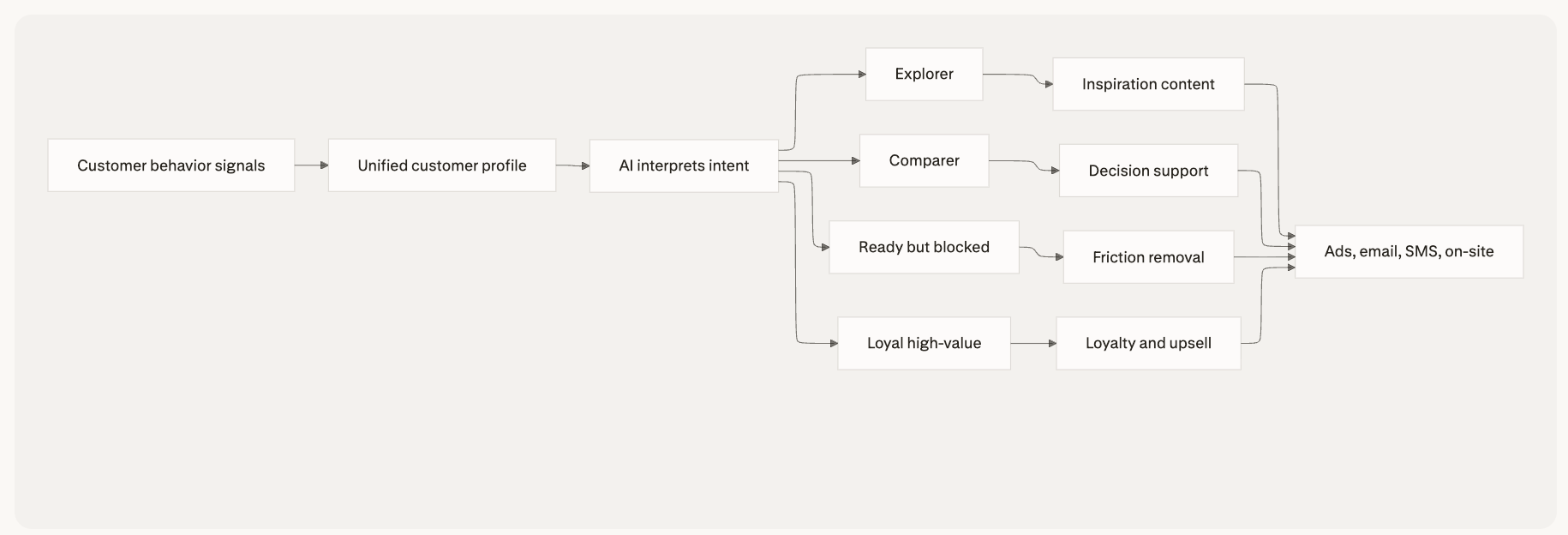
What matters is not the diagram itself, but the logic behind it Customer behavior generates signals. Those signals are connected into one profile. AI helps interpret what that profile suggests about intent. Then the brand responds through the channels it already uses: ads, email, SMS, app, or on-site experiences.
To anchor this abstract concept in a tangible scenario
Envision a prospective shopper who navigates to your site via an Instagram campaign, spending several minutes scrutinizing summer dresses and high heels without committing any items to their digital shopping cart.
While this specific sequence of actions undoubtedly signifies genuine interest, it simultaneously indicates a lack of immediate purchase readiness; thus, the most appropriate brand response leans toward the editorial — showcasing curated style inspirations, highlighting best-selling collections, leveraging social proof, or engaging in immersive category storytelling.
However, should that very same individual return forty-eight hours later to select items, initiate the checkout process, and unexpectedly abandon the session at the shipping calculation stage, the contextual landscape shifts dramatically.
Retargeting efforts must immediately pivot to mitigate this specific transactional friction, prioritizing messaging that clarifies delivery timelines, reassures the user regarding return policies, highlights secure payment infrastructure, and—only as a last resort—introduces a calculated financial incentive.
A simple way to explain the same process is with a second flow focused on the customer journey:
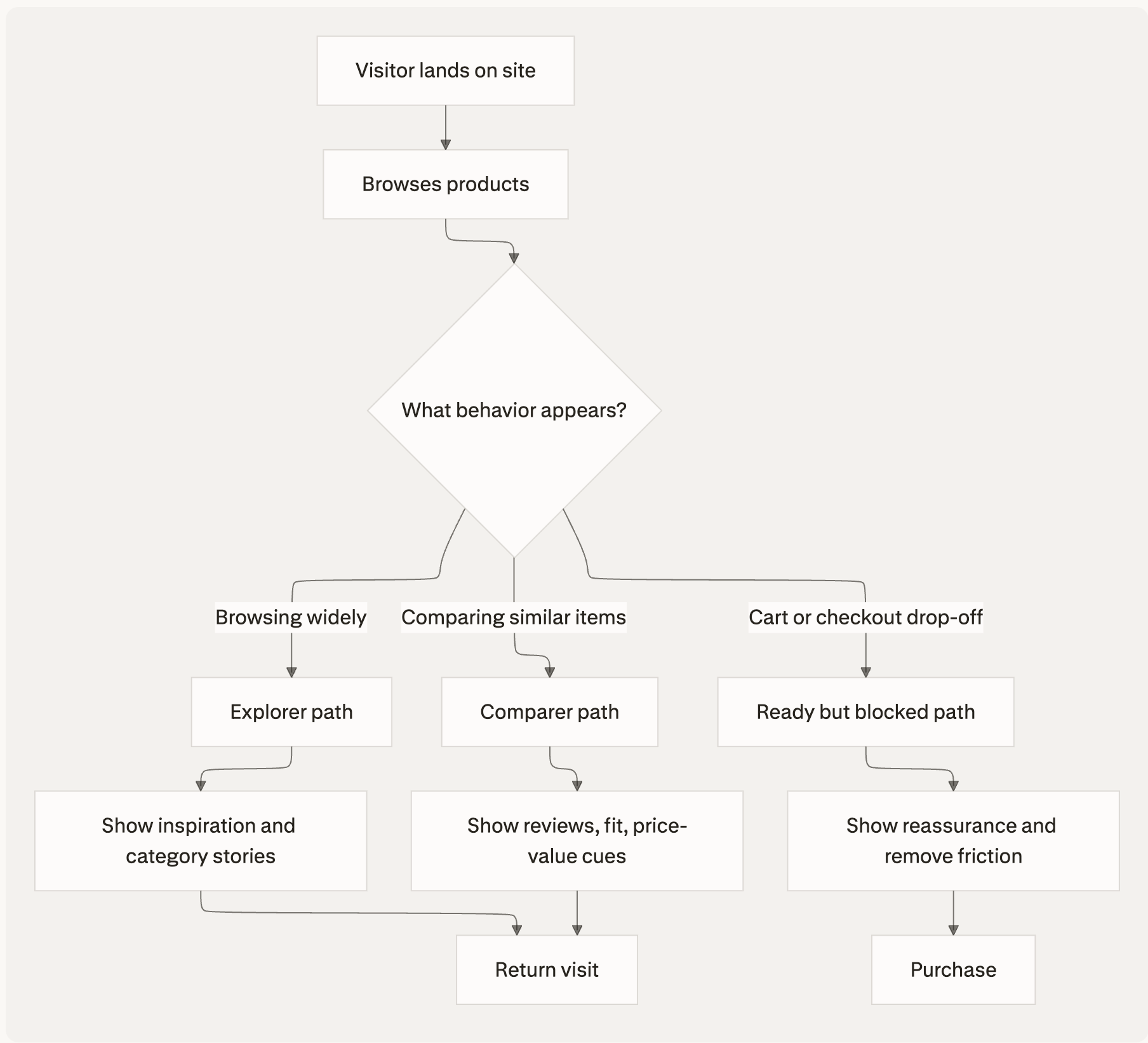
The same person can move from one intent state to another: dynamic retargeting becomes powerful when it adapts to that movement instead of freezing the customer in one rigid audience.
Strategy 2: Forgotten data
The second strategy is often even more valuable because it uses data most brands ignore.
This strategy capitalize latent data reservoirs that the vast majority of brands inexplicably ignore: this so-called “forgotten data”.
“Forgotten data” includes two critically important demographic cohorts: people who engaged but never bought, and customers who bought in the past but have gone inactive. These groups are not just leftovers in the database. They are signals about acquisition quality, onboarding quality, product relevance, and retention health.
The first group is made of users who subscribed, clicked, browsed, maybe even came back more than once, but never converted
Some of them later unsubscribe. These people are useful not because the brand should keep messaging them after consent is gone, but because they reveal where the marketing journey failed. The unsubscribe itself is not the only insight but the path before the unsubscribe is the real lesson.
That is why forgotten data should be treated as a diagnostic layer. It tells you which sources bring low-quality leads, which welcome journeys create mismatched expectations, and which content makes people lose interest.
In other words, unsubscribes are not only a compliance event; they are a feedback signal for strategy. Aggregated analysis of unsubscribes and non-buyers can show which campaigns and messaging patterns are driving weak-fit audiences.
The second group is dormant customers
These are usually more commercially valuable because they already crossed the hardest threshold once: trust. They know the brand, they have bought before, and they may still be recoverable, the question is not simply how to “reactivate” them, a better question is why they stopped responding, and what kind of re-entry path makes sense for each type of dormant customer.
Here is the conceptual flow for forgotten data:
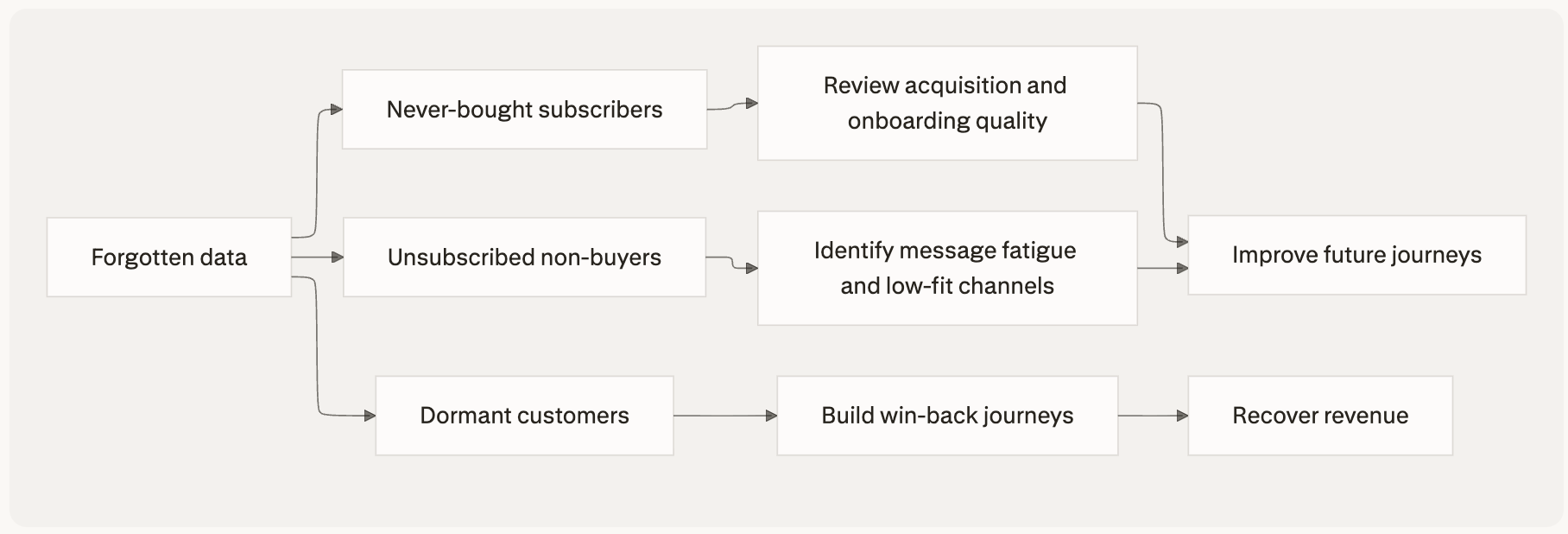
Forgotten data is not just about sending another campaign, It's about learning from weak signals and using that learning to improve both future acquisition and current retention.
For unsubscribed non-buyers, the best use is analysis.
- Where did they come from?
- Which promise did they respond to?
- What did they browse?
- At what point did they disappear?
If a brand attracts thousands of signups through discount-led messages but those users never buy and quickly opt out, the problem is not the email platform. The problem is that the acquisition promise and the real customer fit are misaligned.
Dormant customers require a different approach: AI helps identify who is most likely to come back and what kind of trigger may work best. Some people just need rediscovery: “Here’s what’s new.” – may simply require a gentle phase of rediscovery, softly prompted by updates highlighting innovative collections or brand evolutions.
Some need relevance: “Here’s what matches what you liked before.” Some need a reason to act now: early access, shipping, exclusivity, or, for selected cases, a targeted offer. Bloomreach describes intent and engagement in ways that support this kind of customer interpretation, while Connectif emphasizes real-time automation and personalization for e-commerce journeys.
A win-back flow example to re-activate your customer database:
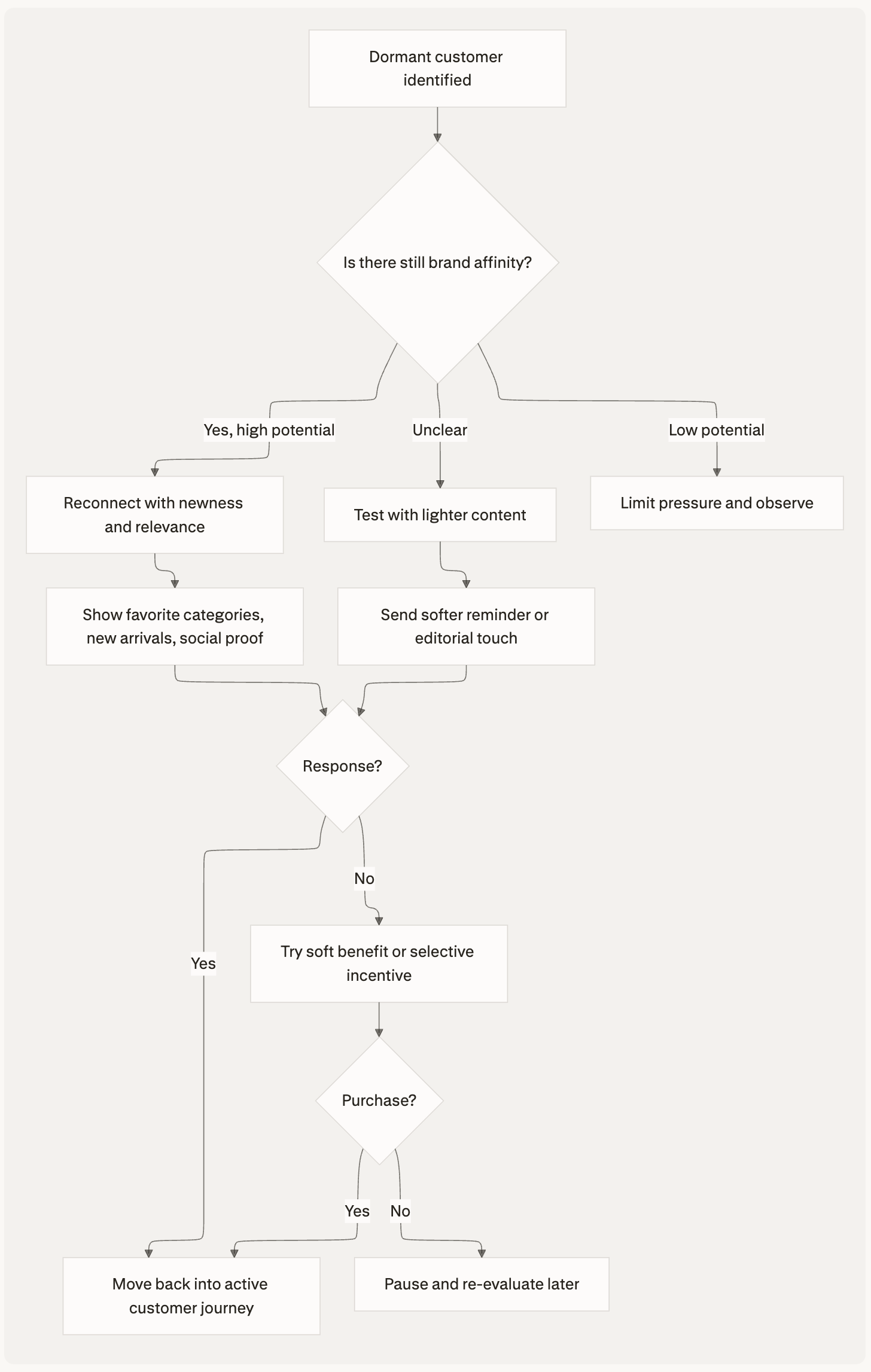
Re-engagement should not begin with a discount by default.
It should begin with relevance, because relevance protects both margin and brand perception. Incentives should come later, and only where there is a real business case for them.