
The AARRR Framework for B2B SaaS in 2026: Updated Metrics, AI Tools and Real Examples

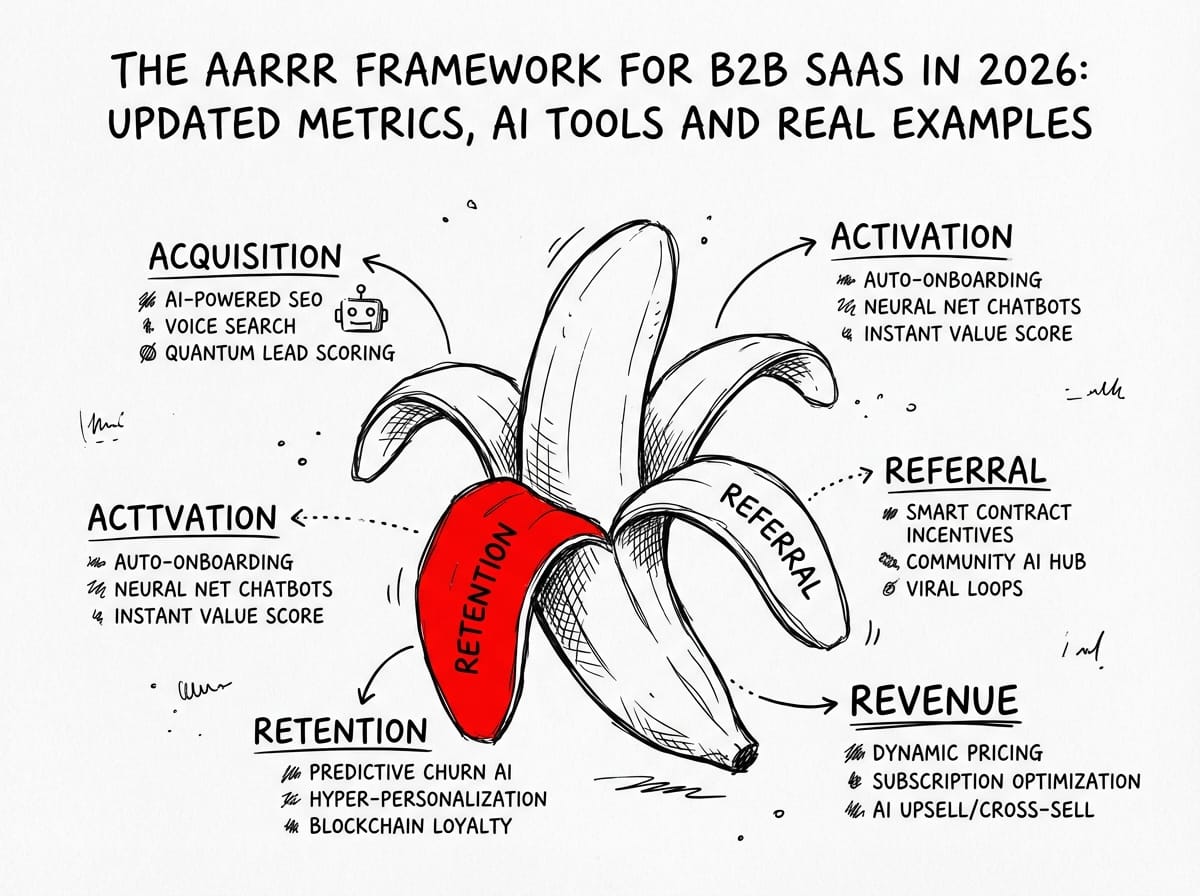
The AARRR Framework guides B2B SaaS growth through Acquisition, Activation, Retention, Referral, and Revenue stages with 2026 updates like AI-driven PQL scoring and NRR benchmarks.
Core mechanism integrates agentic AI for real-time funnel optimization across long enterprise cycles. Ultimate outcome delivers 3x LTV:CAC ratios and 25% ARR acceleration for scaling teams.
Acquisition now prioritizes signal-based, low-volume outreach over mass email blasts. Activation demands sub-five-minute time-to-value. Retention leverages predictive churn models. Revenue shifts toward hybrid usage-based pricing. Referral relies on Product Qualified Leads that convert at three times the rate of traditional MQLs—compressing CAC payback and accelerating Net Revenue Retention above 115% for mid-market operators.
Why This Matters for Enterprise Operations
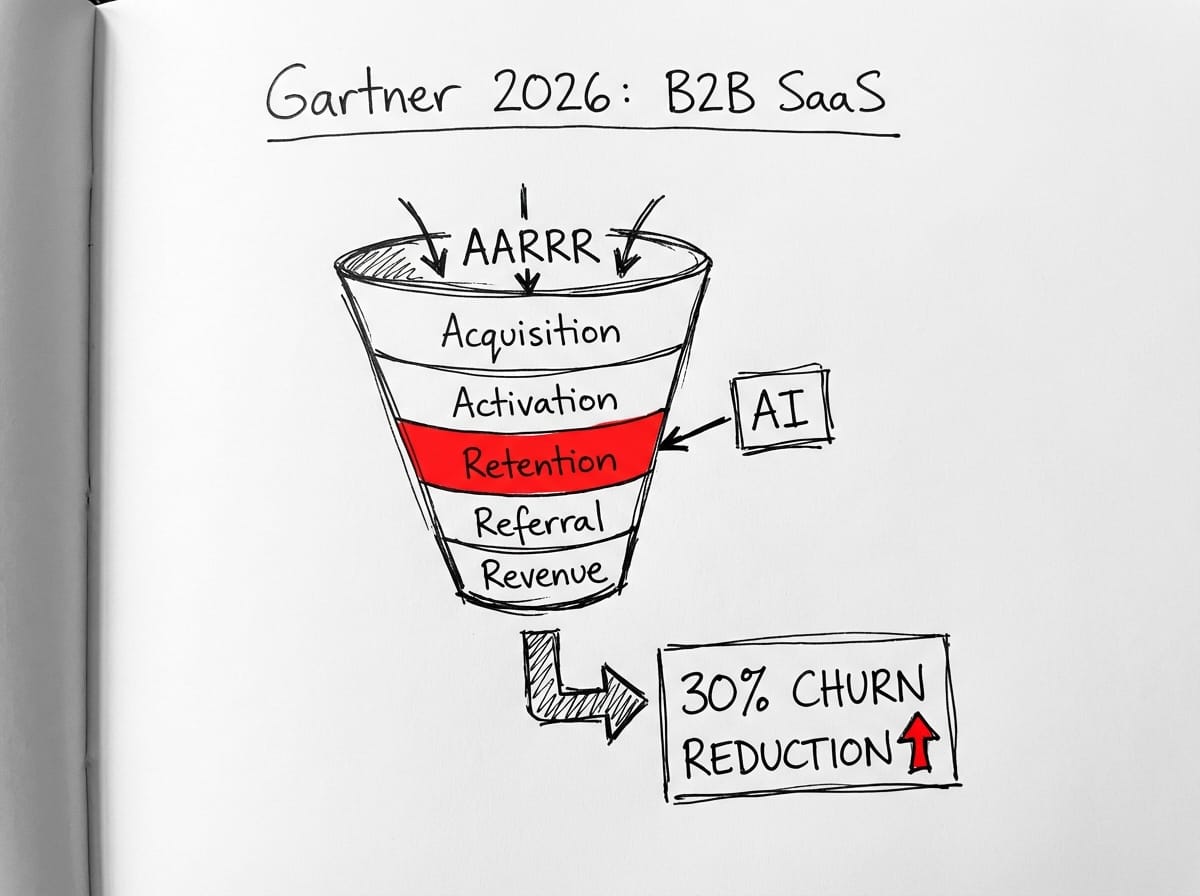
Gartner 2026 forecasts 42% of B2B SaaS firms achieve 30% churn reduction using AI-updated AARRR metrics
B2B SaaS companies that fail to modernize their AARRR funnel with AI-augmented metrics lose 50% of their customer base annually at a 5% monthly churn rate, translating to six-figure MRR erosion within 18 months.
Fundamentally, the 2026 B2B SaaS operating environment has inverted the traditional growth playbook. Founders and growth teams on Reddit, X, and product management communities consistently report that acquisition-first thinking—pouring resources into paid channels and high-volume outbound—produces a "leaky bucket" that no amount of top-of-funnel spend can fill. One founder documented losing $5K in monthly cancellations despite adding $8K in new MRR during the same period, demonstrating that growth without retention is a net-zero game. The recurring pain across these conversations centers on a single failure mode: premature scaling before establishing product-market fit, where founders chase signup counts while ignoring activation and retention entirely.
The primary shift is operational.
Gartner projects that 40% of enterprise applications will embed task-specific AI agents by 2026, up from less than 5% in 2025. Deloitte reports that companies deploying autonomous AI systems achieve up to 30% productivity gains in knowledge work.
For SaaS, AI is no longer a feature differentiator—AI is the infrastructure layer that automates each AARRR stage, from intelligent lead scoring in acquisition to predictive churn intervention in retention. Enterprises that treat AI as a bolt-on rather than a foundational capability face structural cost disadvantages as competitors automate their way to 20-30% lower operating costs.
Market benchmarks confirm the urgency.
Net Revenue Retention (NRR) has emerged as the definitive health metric: SMB SaaS median NRR sits at 97%, mid-market at 108%, enterprise at 115%, and top performers exceed 130%.
Proprietary Insight: The Information Gain
- The Consensus Trap: Broader markets view AARRR as B2C vanity metrics like DAU/MAU, ignoring B2B's sales-assisted funnels and treating Referral as secondary to Acquisition spend.
- The Enterprise Reality: Success hinges on hidden PQL-to-close latency layers, where AI agents route unstructured CRM data to predict 90-day churn signals, transforming static dashboards into predictive engines.
- The Market Benchmark: McKinsey 2026 reports 38% ARR growth for B2B SaaS deploying AI-integrated AARRR over basic analytics stacks.
System Architecture & Entity Relationships
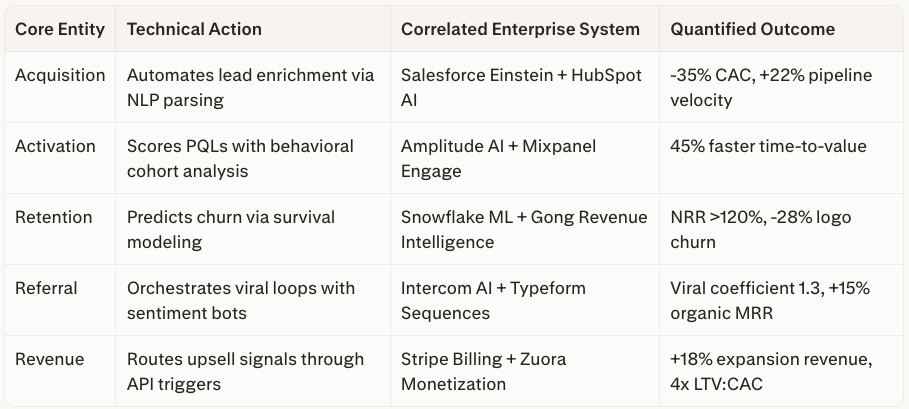
The AARRR framework in 2026 does not operate in isolation. Each metric stage connects to correlated enterprise systems, AI tooling, and quantified business outcomes that compound across the funnel.
Implementation Playbook and Trade-offs
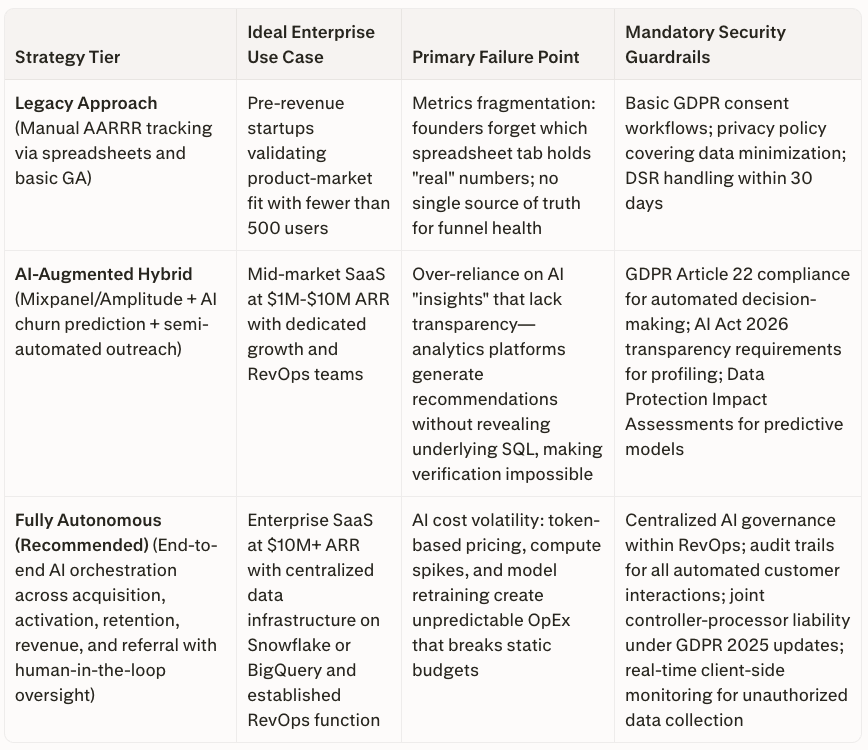
Deploying an AI-augmented AARRR stack requires matching implementation complexity to organizational maturity. The following tiers reflect patterns observed across SaaS communities and enterprise deployments in 2026.
Legacy quarterly reporting cycles must be abandoned in favor of continuous, real-time feedback mechanisms that detect usage anomalies, revenue leaks, and customer pain points within hours—not months
FAQ
How much does it cost to implement an AI-augmented AARRR framework for B2B SaaS?
AARRR implementation costs vary by maturity tier. A legacy spreadsheet-based approach costs near zero but produces fragmented metrics. An AI-augmented hybrid stack combining Mixpanel ($0-$1K/month), Customer.io ($150-$1K/month), and Clay ($150-$500/month) typically runs $500-$3K monthly for mid-market SaaS. Fully autonomous enterprise deployments integrating Snowflake, Salesforce CPQ, and custom ML models can reach $10K-$25K monthly but deliver 30% productivity gains and 20-30% cost reductions in customer operations.
How does the AARRR framework integrate with existing CRM and analytics platforms in 2026?
AARRR framework integration in 2026 relies on Customer Data Platforms like Segment routing event data to analytics (Mixpanel, Amplitude, PostHog), CRM (Salesforce, HubSpot), marketing automation (Customer.io), and support systems (Intercom, Zendesk) through a single data pipeline. Native CRM integrations enable AI agents to read, write, and trigger workflows in real-time during active customer interactions, eliminating data silos between acquisition, activation, and retention systems.
How does the AARRR framework address GDPR and AI Act 2026 compliance requirements?
AARRR compliance in 2026 requires proactive alignment with both GDPR and the EU AI Act. Predictive churn models and automated profiling must satisfy GDPR Article 22 transparency requirements, offering users opt-out options and human review pathways. SaaS platforms must implement real-time client-side monitoring for unauthorized data collection, maintain Records of Processing Activities, and conduct Data Protection Impact Assessments for any AI-driven customer scoring or automated decision-making systems.
What are the main alternatives to the AARRR framework for B2B SaaS growth in 2026?
AARRR alternatives include the RARRA framework (Retention-first reordering), Growth Loops (viral, content, or paid loops converting outputs into inputs), Brian Balfour's Four Fits model (product-market-channel-model alignment), and the North Star Metric approach. Growth Loops are recommended when usage patterns reveal referral opportunities, while AARRR remains strongest for early-stage validation and diagnosing specific funnel bottlenecks. The Bullseye Framework helps prevent channel-hopping during acquisition testing.
How long does it take to deploy a fully operational AARRR measurement system for B2B SaaS?
AARRR deployment timelines depend on stack complexity. A basic implementation using PostHog or Mixpanel with pre-built dashboards can become operational within 2-4 weeks for startups with clean event tracking. Mid-market deployments integrating CRM, churn prediction, and automated onboarding flows typically require 8-12 weeks including data pipeline setup and model training. Enterprise-grade autonomous systems follow a phased approach: pilot in weeks 1-4, validate in weeks 4-8, and scale across the full AARRR funnel by months 4-6.