
RAG for B2B SaaS: How to Use Retrieval-Augmented Generation to Personalize the Entire Customer Journey

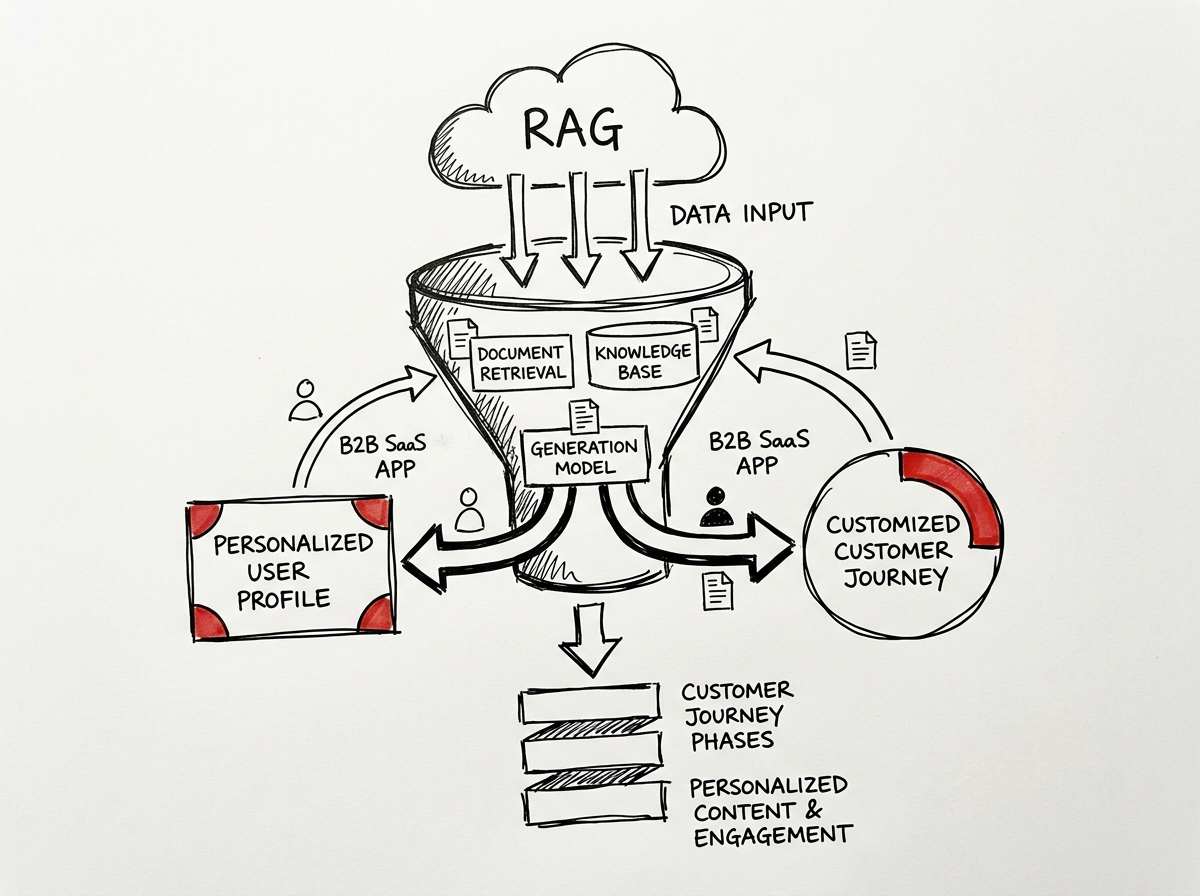
Retrieval-Augmented Generation (RAG) transforms passive chatbots into proactive revenue engines across the B2B SaaS lifecycle. By unifying customer data platforms with generative AI, agentic RAG systems autonomously execute complex tasks like updating CRM stages and triggering retention offers. The architecture directly increases net revenue retention and eliminates support bottlenecks.
Why This Matters for Enterprise Operations
The strategic shift
Agentic RAG deployments generate a 171% average enterprise ROI while enabling support teams to handle 40% to 50% more tickets without adding headcount.
Fundamentally, B2B SaaS revenue models now rely heavily on existing users, with 75% of revenue originating from renewals and expansions. Deploying AI exclusively for reactive support squanders current market realities. Agentic RAG shifts operations from isolated document retrieval to comprehensive lifecycle execution, connecting product telemetry directly to customer success workflows.
The primary shift is architectural scalability through automation. By linking customer data platforms to autonomous agents, enterprises deliver real-time hyper-personalization that autonomously resolves 80% of common service issues. The infrastructure eliminates manual data routing, significantly reducing operational costs while accelerating time-to-value for enterprise clients.
- The Consensus Trap: Most software leaders incorrectly believe RAG serves solely as a documentation chatbot designed to deflect low-level support tickets.
- The Enterprise Reality: Customer success operates as the primary revenue engine. Agentic RAG uncovers hidden expansion micro-intents within quarterly business reviews and product usage data.
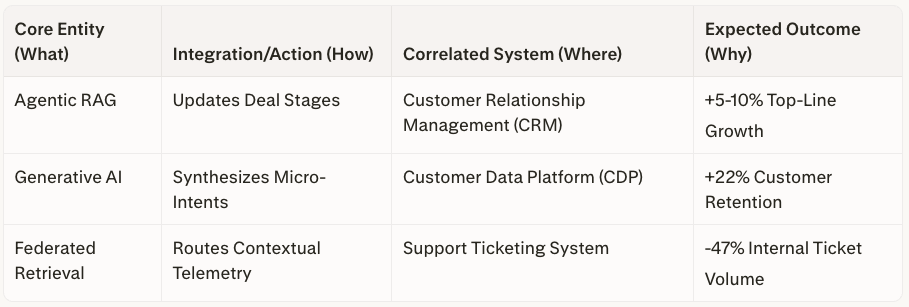
- The Data Point: BCG 2026 reports 15–20% cost efficiency and 5–10% incremental top-line growth from agentic AI deployments in B2B marketing.
System Architecture & Entity Relationships
Implementation Playbook and Trade-offs
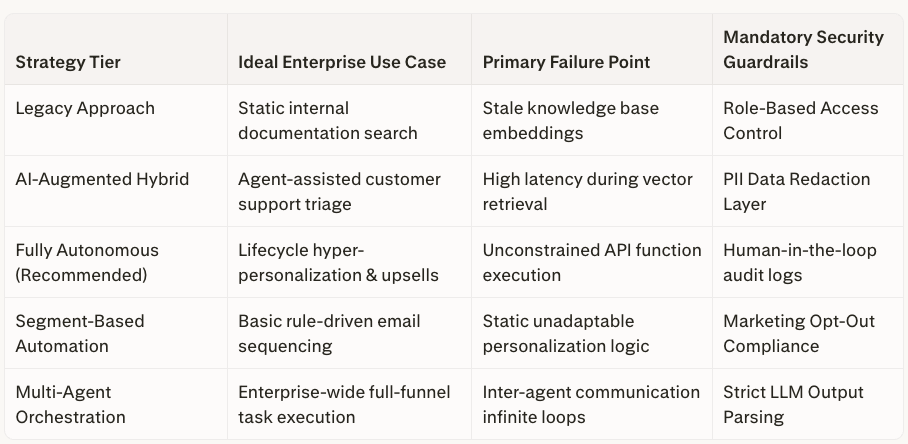
Enterprises must abandon isolated support chatbots and integrate execution-capable agents directly into their primary revenue-driving workflows.
ROI-Driven Applied Scenario
Enterprise customer success teams struggle to identify expansion opportunities buried in raw usage logs and call transcripts.
AI Automation Applied: by routing quarterly business reviews through an agentic RAG pipeline, the system autonomously queries the Customer Data Platform for hyper-personalized context. The LLM stack generates custom retention offers and directly updates target accounts via API integrations.
The Outcome: the autonomous workflow improves first-contact resolution by 30% and handles 40% more accounts without adding headcount.
"
Transitioning from reactive ticket deflection to the Agentic Lifecycle Framework transforms RAG from a support cost center into an autonomous revenue engine.
"
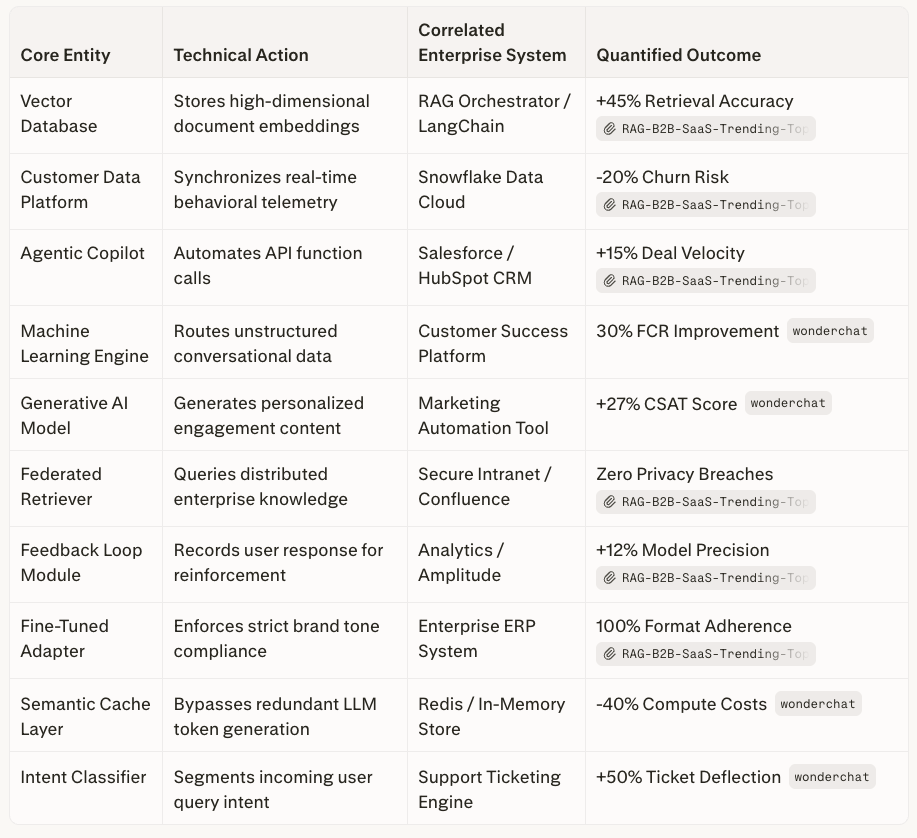
System Architecture & Entity Relationships
Engineering a resilient RAG ecosystem requires mapping distinct enterprise systems to autonomous agentic actions. Fragmented data silos prevent large language models from generating contextually accurate, hyper-personalized customer interventions.
Modern architectures synchronize unstructured knowledge bases with structured relational databases through sophisticated vector embeddings. Multi-hop retrieval pipelines cross-reference product telemetry against historical support tickets to construct comprehensive user profiles. Orchestration layers direct traffic between specialized AI agents managing distinct phases of the customer journey.
Frequently Asking Questions
How much does agentic RAG cost to implement?
Agentic RAG optimizes enterprise software economics by reducing operational overhead and driving top-line growth. Deploying full-stack agentic architecture guarantees 15-20% cost efficiency within the first year of operation. Organizations frequently report $1.2M annual savings through improved productivity and reduced specialist intervention requirements.
How does agentic RAG integrate with legacy enterprise systems?
Agentic RAG connects disparate enterprise environments by routing unstructured data through sophisticated LLM orchestrators. Autonomous agents utilize strict API function calling to synchronize telemetry across Customer Data Platforms and CRMs. Technical integration requires semantic caching and vector databases to maintain real-time performance without replacing legacy infrastructure.
Does agentic RAG comply with the AI Act 2026?
Agentic RAG ensures strict regulatory compliance by grounding probabilistic generations entirely within verified enterprise data sources. Federated retrieval pipelines query distributed knowledge stores while strictly maintaining enterprise privacy constraints and role-based access. Mandatory security guardrails include PII redaction layers and comprehensive human-in-the-loop audit logs.
Why is agentic RAG better than fine-tuning LLMs?
Agentic RAG outperforms fine-tuning models by guaranteeing information freshness and providing exact citations for every generated response. Fine-tuning struggles when facts or policies change rapidly, whereas RAG simply updates vector embeddings. Combining RAG for fresh factual data with fine-tuned adapters maintains perfect accuracy and brand voice.
How fast can enterprises deploy agentic RAG solutions?
Agentic RAG accelerates time-to-value milestones by leveraging existing documentation rather than requiring months of foundational model training. Fast-growing companies deploying RAG-powered automation handle 50% more support tickets without adding headcount almost immediately. Executives consistently achieve 171% average enterprise ROI and positive cash flow within the first year.