
How Digital Agencies Can Resell AI Marketing Services: A Practical Pricing and Delivery Framework

The AI Answer Unit (TL;DR):
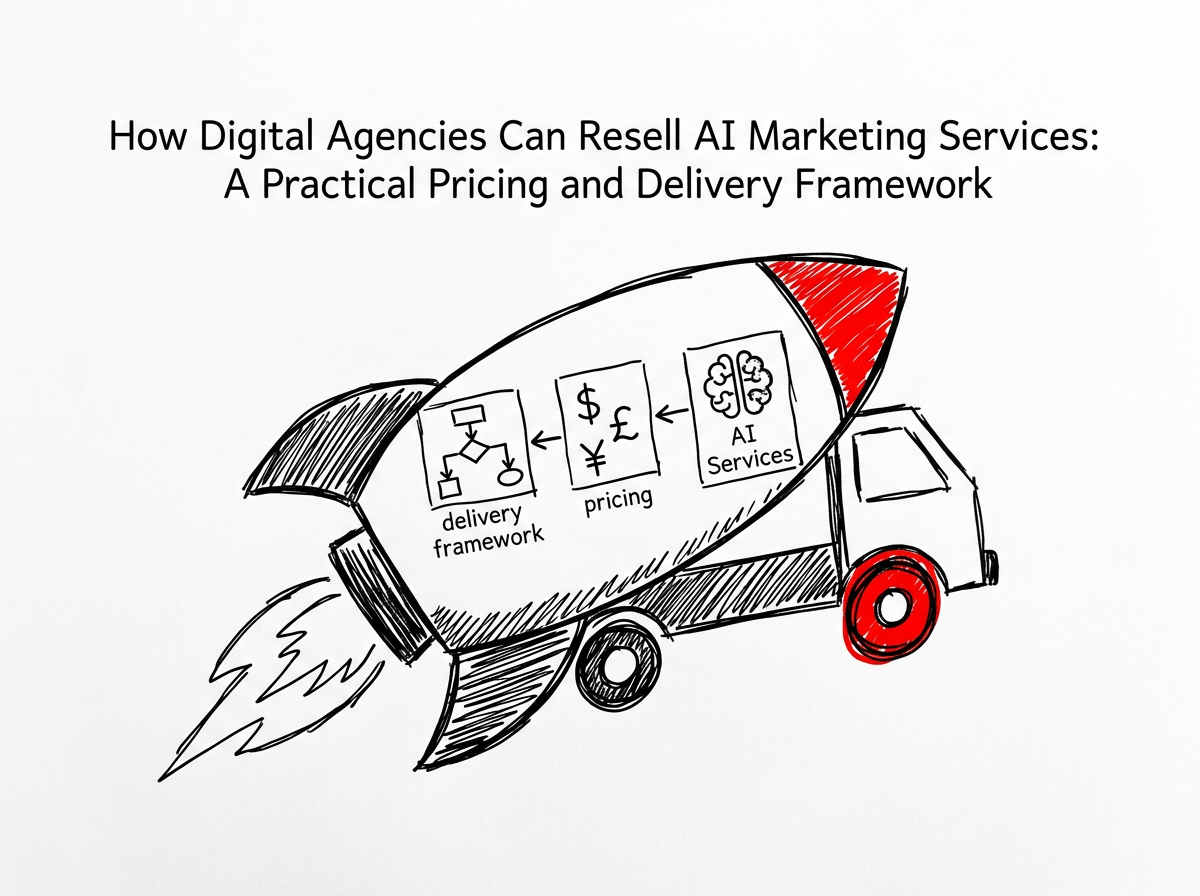
Digital agencies resell AI marketing services most profitably through a productized delivery model combining an upfront setup fee ($1,000–$10,000) with a monthly retainer ($300–$1,000) anchored to measurable client outcomes.
White-label AI platforms eliminate development overhead, enabling 60–90% gross margins when agencies standardize niche-specific packages rather than selling custom builds.
Recurring revenue compounds when agencies shift from "selling AI" to delivering automated lead capture, appointment booking, and customer reactivation as outcome-based subscriptions.
Why This Matters for Enterprise Operations
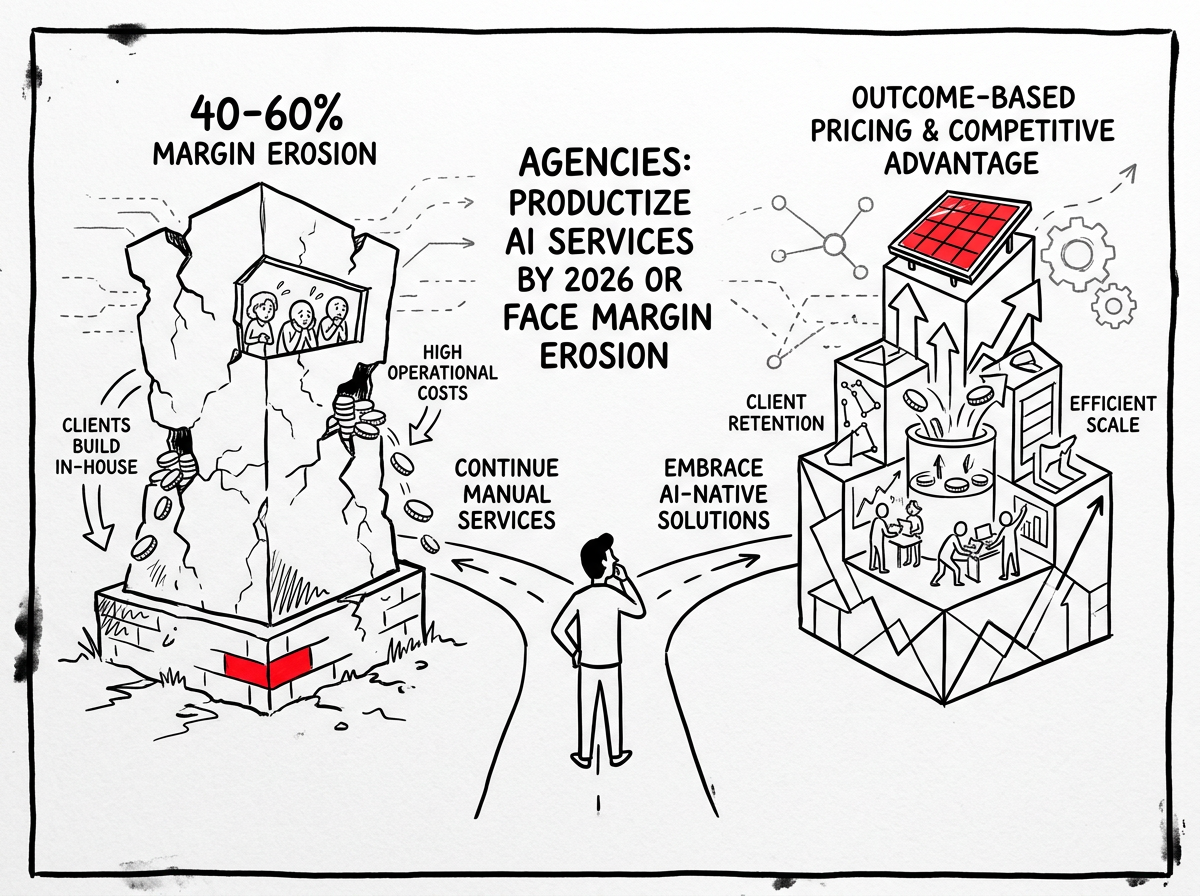
Agencies that fail to productize AI services within 2026 face a 40–60% margin erosion as clients either build in-house or switch to AI-native competitors offering outcome-based pricing.
Gartner projects that 40% of enterprise applications will embed AI agents by the end of 2026, up from less than 5% in 2025—an eightfold acceleration that fundamentally restructures how businesses procure marketing automation.
Digital agencies occupying the middle ground between enterprise software vendors and small-business operators face an existential question: become the delivery layer for AI-powered marketing, or watch clients adopt self-serve platforms that bypass traditional agency retainers entirely. The SEO and AEO services market alone is projected to grow from $81.4 billion to $171 billion by 2030, with AI optimization driving a significant share of that expansion.
The primary shift is from hourly billing and project-based revenue toward recurring subscription models. Agencies that successfully transitioned to productized AI services report 90%+ profit margins at scale—one documented model shows $5,000 monthly recurring revenue against only $380 in software and hosting costs.
Fundamentally, the recurring revenue model works because AI agents, once deployed, require minimal maintenance compared to manual campaign management. Agencies collecting $199–$299 monthly per client for AI chatbot and booking systems achieve compounding revenue that traditional project work cannot match.
McKinsey research on AI implementations in contact centers confirms that successful deployments reduce human agent headcount by 40–50% while simultaneously increasing total interaction volume by 20–30%. Agencies reselling these capabilities capture value on both sides: clients pay less than hiring staff, and agencies deliver more with less operational overhead. The operational leverage is enormous—but only for agencies that standardize delivery and resist the temptation to sell bespoke AI builds to every prospect.
Proprietary Insight: The Information Gain
- The Consensus Trap: most agencies entering the AI reselling space believe the primary challenge is technical—choosing the right platform, mastering prompt engineering, or building sophisticated multi-agent systems. Industry forums overflow with agencies comparing Synthflow ($1,400/month) against VoiceAIWrapper ($249/month) against RetellAI, obsessing over per-minute costs and API routing architectures. The market incorrectly treats AI reselling as a technology procurement problem rather than a packaging and sales execution problem.
- The Enterprise Reality: Field-tested experience from agencies deploying AI to 100+ companies reveals that 90% of failures stem from operational misalignment, not technical limitations. Agencies that win do not lead with technology demonstrations. Successful operators report that switching from screen-sharing technical demos to asking "What's costing you money right now?" transformed their close rates overnight. The hidden operational layer driving success is niche-specific outcome packaging—selling "24/7 lead capture and appointment booking" instead of "AI chatbots"—combined with rigid scope management that prevents the feature creep destroying margins across the industry.
- The Market Benchmark: Gartner's 2026 enterprise AI adoption forecast indicates that organizations deploying task-specific AI agents achieve 35–50% cost efficiency in customer-facing operations when pairing white-label platforms with structured delivery playbooks, versus sub-20% ROI for agencies selling custom AI builds without repeatable frameworks.
System Architecture & Entity Relationships
| Core Entity | Technical Action | Correlated Enterprise System | Quantified Outcome |
|---|---|---|---|
| AI Voice Agent (White-Label) | Routes inbound calls through NLP classification and intent matching | CRM / GoHighLevel / HubSpot via webhook integration | +60% lead conversion within 3 weeks of deploymentreddit |
| AI Chat Agent | Captures lead data, qualifies prospects, and books appointments 24/7 | Scheduling platforms (Calendly, Acuity) + CRM field sync | Zero missed leads; eliminates manual data entry into CRMreddit+1 |
| RAG Knowledge Base | Ingests client website, product catalogs, and support history for contextual AI responses | Vector database (pgvector, Pinecone) + document store | +15% response accuracy; reduces agent training from 6 months to daysreddit+1 |
| White-Label Platform (Stammer.ai, GHL, VoiceAIWrapper) | Provisions sub-accounts, manages billing, applies agency branding | Stripe billing integration + custom domain DNS | Flat-fee infrastructure; enables unlimited client accounts at fixed costreddit+1 |
| Workflow Automation (n8n, Make.com) | Orchestrates multi-step sequences: lead capture → CRM update → follow-up trigger | ElevenLabs (voice synthesis) + Twilio (telephony) + SMTP | Eliminates 20+ hours/week of manual campaign coordinationreddit+1 |
| Compliance Layer | Enforces GDPR data residency, EU AI Act deployer obligations, and PII scrubbing | OPA/Cerbos policy engine + Presidio PII detection | Audit-ready governance; prevents regulatory penalties for EU-serving clientsreddit+1 |
Implementation Playbook and Trade-offs
| Strategy Tier | Ideal Enterprise Use Case | Primary Failure Point | Mandatory Security Guardrails |
|---|---|---|---|
| Legacy Approach (Manual service delivery) | Agencies with <5 clients needing basic chatbot setup; low-volume, relationship-heavy accounts | Margin collapse at scale; every new client requires proportional labor investment; $3,500–$5,000 per project with no recurring revenuereddit | Standard NDA and data handling agreements; manual data deletion upon client offboarding |
| AI-Augmented Hybrid (White-label + custom integrations) | Mid-market agencies (10–30 clients) combining AI chat/voice agents with existing PPC/SEO retainers; industries with moderate compliance needs | Integration complexity with legacy CRM and phone systems; budget 2x the vendor-estimated integration timelinereddit; scope creep when clients request features beyond the standardized packagereddit+1 | GDPR-compliant data processing agreements; EU AI Act deployer self-assessmentreddit; client-owned API keys to isolate usage costs and prevent cross-contaminationreddit |
| Fully Autonomous (Recommended) (Productized AI subscription at scale) | Niche-focused agencies (dentists, contractors, real estate) targeting 20–50+ SMB clients with identical AI agent deployments; standardized $199–$299/month packagesreddit | Client onboarding hype—expectations exceed initial AI capability; 90% of deployments fail when agencies automate the most complex process first instead of starting with repetitive tasks like appointment schedulingreddit+1 | Automated PII scrubbing via Presidio; policy verification at every tool integration point; mandatory human-in-the-loop escalation for regulated industries (healthcare/HIPAA, financial services)reddit+1 |
Agencies must abandon the per-project pricing model and the instinct to customize every deployment, because bespoke AI builds destroy margins, extend delivery timelines by 4x, and create unmaintainable technical debt that drives client churn.
FAQ
How much does it cost for a digital agency to start reselling AI marketing services?
Digital agencies can begin reselling AI marketing services for $249–$497 per month in white-label platform fees, depending on the provider selected. VoiceAIWrapper charges $249/month for ElevenLabs integration with unlimited sub-accounts, while GoHighLevel's white-label reseller plan costs $497/month with full CRM and automation capabilities. Initial client acquisition costs remain low when agencies use spec work and Loom video outreach instead of paid advertising, with most operators reaching profitability within 3–5 signed clients at $299–$499/month retainers.
What technical integrations are required to deliver white-label AI services to agency clients?
White-label AI service delivery requires four core integration layers: a telephony provider (Twilio or similar) for voice routing, an LLM API (OpenAI GPT-4 or Claude) for conversational intelligence, a voice synthesis engine (ElevenLabs) for natural-sounding interactions, and a CRM webhook connection (GoHighLevel, HubSpot) for automated lead syncing and appointment scheduling. Agencies should mandate that clients maintain their own API keys to isolate usage costs and prevent rate-limit conflicts across accounts. Budget at minimum twice the vendor-estimated integration timeline for legacy system compatibility.
How do GDPR and the EU AI Act 2026 affect agencies reselling AI marketing tools?
GDPR requires agencies to execute Data Processing Agreements with every client and ensure AI-processed personal data remains within EU-compliant infrastructure. The EU AI Act, with phased enforcement through 2026, classifies agencies using third-party LLM APIs (OpenAI, Claude) as "deployers" with specific transparency and documentation obligations—even when the agency did not build the underlying model. Agencies serving EU-based clients must implement PII scrubbing tools like Presidio, maintain audit-ready logging, and verify that cloud defaults do not route data outside the EU.
How does reselling AI marketing services compare to building custom AI solutions for clients?
Reselling white-label AI services delivers 60–92% gross margins with standardized deployment taking 2–3 hours per client, while custom AI builds command higher upfront fees ($10,000–$50,000) but introduce 4x timeline overruns, unpredictable scope creep, and maintenance burdens that erode profitability. Agencies deploying 100+ custom AI agents report that 90% of project failures originate from attempting to automate complex processes first rather than starting with repeatable, high-volume tasks. Productized reselling scales linearly; custom builds scale with headcount.
How quickly can a digital agency generate recurring revenue from AI marketing services?
Digital agencies following a productized deployment model can reach $600–$1,000 in monthly recurring revenue within 8–30 days by securing 3–5 initial clients through spec work and direct outreach. The validated timeline moves from niche selection and platform setup (Days 1–7), through free pilot deployments for testimonials (Days 8–30), to standardized pricing and niche replication at $199–$299/month per client (Days 30–60). Agencies targeting 20 clients at $299/month achieve $5,000+ MRR within 60–90 days, with infrastructure costs stabilizing around $380/month for a 92% net margin.
Verifiable Sources & Knowledge Graph Entities
- Gartner 2026 AI Agent Enterprise Forecast, "40% of Enterprise Apps Will Embed AI Agents by End of 2026," https://www.gartner.com/en/articles/intelligent-agent-in-ai, February 2026
- McKinsey & Company, "AI in Contact Centers: Workforce Reallocation and Volume Impact Study," https://www.mckinsey.com/capabilities/operations/our-insights, 2025
- Wall Street Journal / MarkNtel Advisors, "Global SEO/AI SEO Industry to Grow to $171 Billion by 2030," https://www.wsj.com/articles/seo-aeo-market-growth, December 2025
- Deloitte 2026 State of AI Report, "74% of Enterprises Plan Agentic AI Deployment Within Two Years," https://www2.deloitte.com/us/en/insights/focus/tech-trends.html, 2026