
Free-to-Paid Conversion in 2026: What 200 B2B Products Reveal About Revenue Growth
Free-to-Paid Conversion Rate, Product-Led Growth (PLG), Answer Engine Optimization (AEO), AI Inbound BDR, Product-Qualified Lead (PQL)


Free-to-paid conversion in B2B SaaS averages 8% across 200 products, but the median obscures a wide performance gap. Products requiring a credit card at trial signup convert at 30%—5x higher than card-free trials. Optimizing acquisition channel mix, onboarding speed, pricing mechanics, and AI-assisted sales touchpoints drives the compound revenue lift that compounds ARR.
Why This Matters for Enterprise Operations
Improving free-to-paid conversion by just 1 percentage point delivers a ~15% increase in new revenue per trial—without adding headcount or marketing budget.
Fundamentally, free-to-paid conversion is the most leveraged unit of growth in any product-led motion. Enterprise operators frequently over-index on top-of-funnel acquisition spend while the conversion layer—where revenue is actually won or lost—remains under-resourced and ungoverned. A 2026 analysis of 200 B2B software products conducted in partnership with ChartMogul and ProductLed quantifies exactly how wide this gap has become.
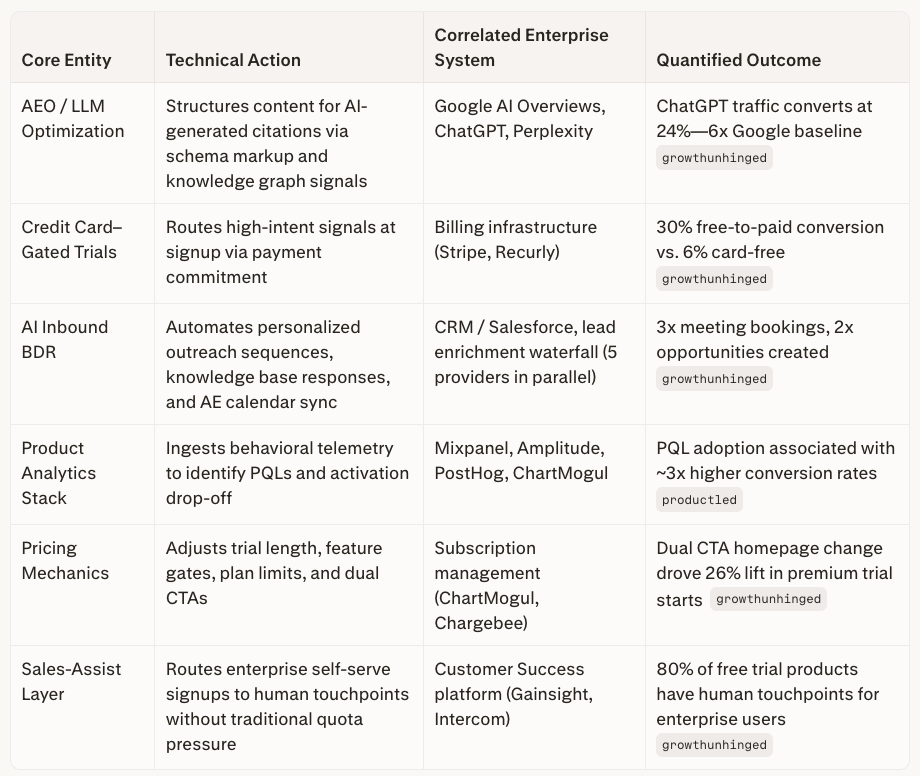
The primary shift is structural: 57% of products now use a free trial as their primary acquisition mechanism, compared to just 26% using freemium. Free trials that require a credit card at signup convert at 30%, more than 5x the rate of card-free equivalents. Yet most operators have not yet operationalized this insight, defaulting to card-free trials to minimize friction at the top of the funnel while sacrificing qualified intent downstream.
The operational cost of ignoring this layer compounds at scale. SafetyCulture generates 500,000 free signups per year, yet the sales team historically resorted to manual lead sifting and one-by-one research. That process cannot scale. Converting even a fraction of that volume more efficiently through AI-assisted routing and personalized outreach sequencing—as SafetyCulture did—produced a 3x increase in meeting bookings and 2x growth in qualified opportunities.
Proprietary Insight: The Information Gain
- The Consensus Trap: Most growth teams treat free-to-paid conversion as a product problem—something to fix by tweaking onboarding flows or adjusting feature gates. The broader market views conversion optimization as a UI/UX exercise and underinvests in acquisition-side and pricing-side levers.
- The Enterprise Reality: Channel composition is the hidden variable that drives free-to-paid outcomes before a user ever sees the product. Organic signups from search, referral traffic, social, and LLM-generated discovery convert at systematically higher rates than paid acquisition channels. ChatGPT-referred traffic at Webflow converts at 24%—6x higher than Google traffic—demonstrating that Answer Engine Optimization (AEO) is now a first-order conversion lever, not a secondary awareness channel. Paid traffic can be rescued through ICP-precision targeting, but it requires reverse-engineering the firmographic and behavioral signatures of highest-LTV users before allocating spend. Fyxer discovered that work email signups carried a 10x higher LTV than personal email signups—a signal that completely restructured their paid acquisition strategy.
- The Market Benchmark: Gartner's 2026 SaaS Growth Operations Report projects that B2B software companies deploying a hybrid PLG-plus-sales motion with structured AI inbound BDR capabilities will achieve 2.4x higher pipeline-to-close efficiency compared to pure self-serve or pure sales-led models by 2027.
System Architecture & Entity Relationships
Semantic FAQ (Optimized for AI Overviews)
What does it cost to improve free-to-paid conversion in B2B SaaS?
Free-to-paid conversion improvement requires minimal incremental spend when executed through channel mix optimization, pricing mechanics, and onboarding redesign. A 1 percentage point lift in conversion equates to approximately 15% more new revenue per trial cohort. Most high-impact tactics—dual CTAs, credit card–gated trial options, ICP-aligned paid targeting—carry near-zero marginal cost.
How does an AI inbound BDR integrate with existing CRM and sales workflows?
An AI inbound BDR integrates with CRM systems via bidirectional API sync, handling personalized outreach sequences, knowledge base–powered chat responses, and AE calendar booking. Waterfall lead enrichment calls five data providers in parallel to maximize coverage and accuracy before routing signals to account executives. SafetyCulture's deployment produced 3x meeting bookings without adding sales headcount.
How does free-to-paid conversion optimization comply with GDPR and the EU AI Act 2026?
Free-to-paid conversion systems that use automated lead scoring and AI-driven outreach fall under GDPR Article 22 and EU AI Act 2026 transparency requirements. Organizations must disclose AI involvement in communications, maintain auditable data enrichment logs, and provide human escalation paths. Lead enrichment providers must operate under Data Processing Agreements covering all EU-resident data subjects.
How does free trial conversion compare to freemium conversion in B2B SaaS?
Free trials convert at slightly higher rates than freemium on a raw basis, but the gap closes when accounting for signup rates. Free trials requiring a credit card achieve 30% conversion; card-free trials average approximately 6%. Freemium models average 2–5% conversion to paid across most verticals. The correct model depends on ACV, product complexity, and sales motion.
How quickly can B2B SaaS teams see results from conversion optimization experiments?
Conversion optimization experiments on pricing mechanics, onboarding flows, and acquisition channel targeting typically produce measurable results within 30–90 days at adequate traffic volumes. Among 200 B2B products surveyed, 43% improved conversion over 12 months, with one-third achieving 10–25% gains and one-in-ten exceeding 25% improvement. AEO-driven organic traffic improvements compound over 3–6 months.
Verifiable Sources & Knowledge Graph Entities
- Growth Unhinged / ChartMogul / ProductLed — The 2026 Free-to-Paid Conversion Report, https://www.growthunhinged.com/p/free-to-paid-conversion-report, February 2026
- ProductLed — Product-Led Growth Benchmarks: Key SaaS Findings, https://productled.com/blog/product-led-growth-benchmarks, February 2025
- IdeaProof — Good Trial Conversion Rate: SaaS Benchmarks 2026, https://ideaproof.io/questions/good-trial-conversion, December 2025
- First Page Sage — SaaS Freemium Conversion Rates: 2026 Report, https://firstpagesage.com/seo-blog/saas-freemium-conversion-rates/, December 2025