
Cookieless Tracking for B2B SaaS: How to Measure Marketing Without Third-Party Cookies in GA4

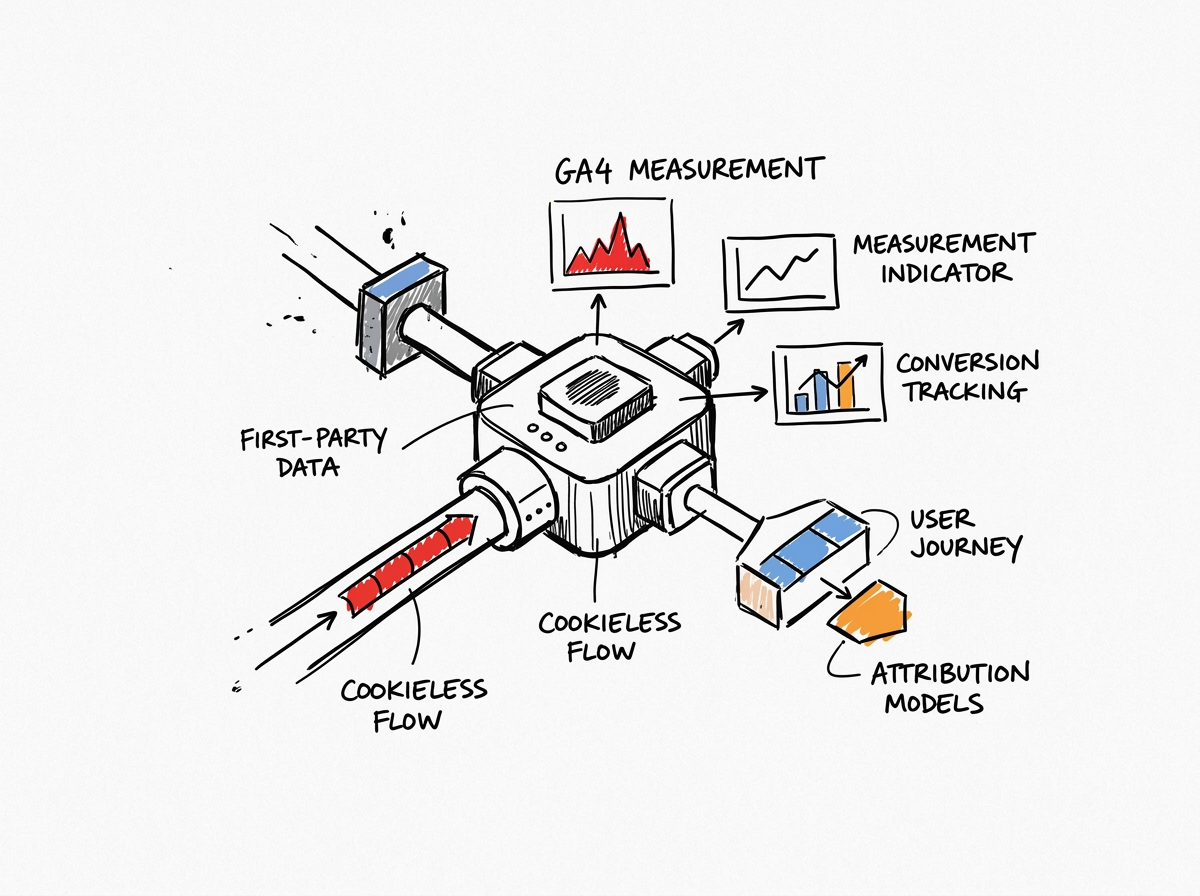
Cookieless tracking in Google Analytics 4 allows B2B SaaS companies to measure complex user journeys and attribute revenue even when prospects reject analytics cookies or browsers block tracking scripts. By combining Google Consent Mode v2, server-side tagging, and machine-learning behavioral modeling, marketers can capture anonymous event pings to successfully reconstruct the buyer journey. This architectural shift protects multi-touch pipeline attribution while remaining fully compliant with increasingly strict global privacy regulations.
Why This Matters Now
Strategic Context
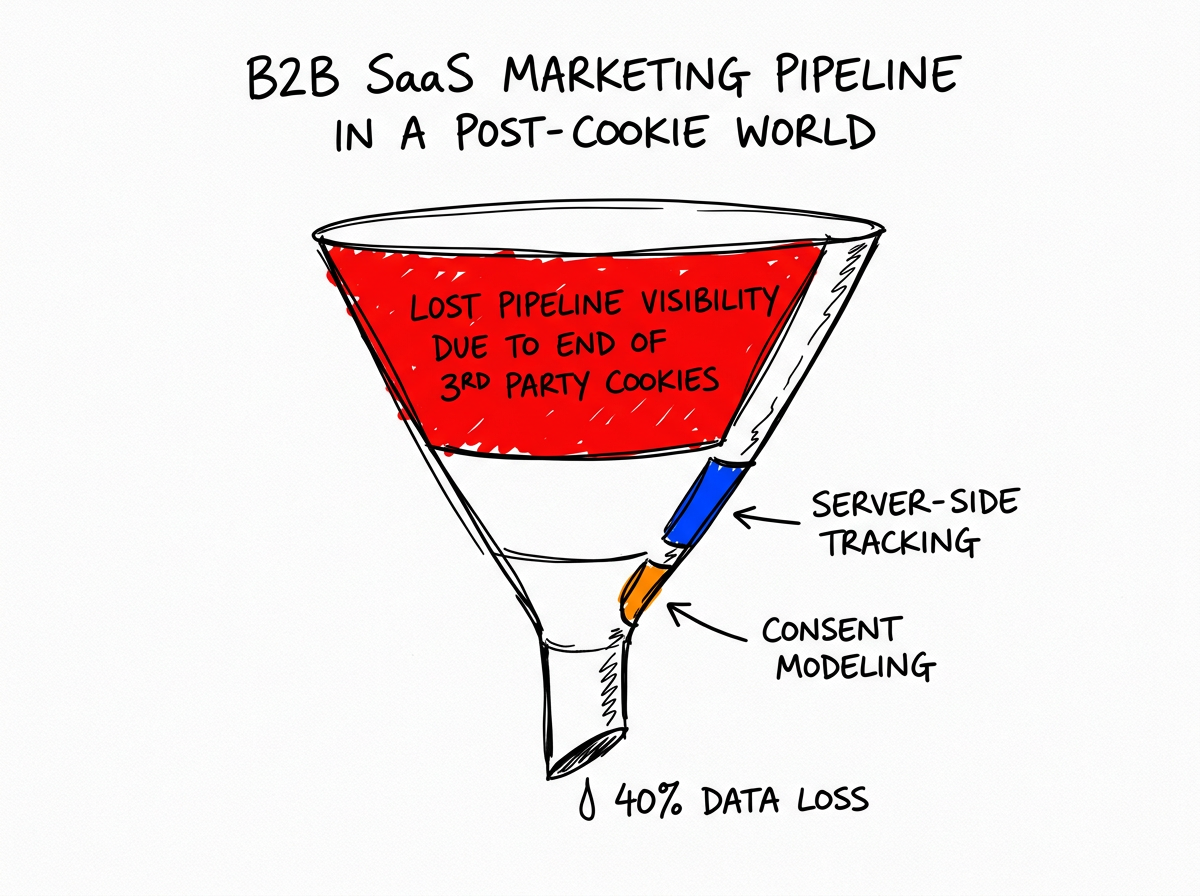
The end of reliable third-party cookies means B2B SaaS companies that fail to adopt server-side tracking and consent modeling will lose visibility into up to 40% of their marketing pipeline.
While Google paused the total forced deprecation of third-party cookies in Chrome in 2025, they replaced the phase-out with prominent user-managed privacy controls. The practical outcome for marketers remains identical, as users are actively opting out of cross-site tracking at record high rates.
B2B SaaS marketing relies heavily on understanding intricate, multi-touch buyer journeys spanning multiple weeks. A prospect might click a LinkedIn ad on their phone, read a blog post, and leave without converting, only to return weeks later via an organic search to request a demo.
Historically, third-party cookies effortlessly stitched this entire cross-device, multi-session journey together. Marketers could comfortably attribute pipeline revenue to the initial paid touchpoint. Without cookies, each of those discrete touchpoints appears as a completely new, disconnected user in legacy analytics platforms.
If a SaaS company ignores this shifting landscape, their marketing attribution will rapidly erode. Paid acquisition campaigns will look artificially expensive because crucial top-of-funnel touchpoints will simply be lost to analytics platforms. Revenue will be inaccurately misattributed to direct traffic or branded organic search because those were the only visible final clicks.
Cookieless tracking serves as the critical technical bridge over this expanding data gap. By leveraging GA4 features like Consent Mode v2 and server-side tagging, businesses can collect privacy-compliant signals. This infrastructure allows integrated machine learning models to effectively fill in the missing pieces.
It is no longer a theoretical exercise for future-proofing your tech stack. Operating without a cookieless attribution framework today means making critical budget allocation decisions based on fundamentally flawed, incomplete pipeline data.
Key Data and Market Reality
Browser restrictions and user opt-outs have rendered traditional client-side tracking functionally obsolete for complex B2B sales cycles.
- The introduction of Google Consent Mode v2 in 2024 made it mandatory to pass explicit consent signals for storage parameters to utilize advanced GA4 audience features and Google Ads measurement.
- B2B SaaS companies rely on accurate multi-touch attribution, yet user opt-out rates on strict GDPR-compliant cookie banners frequently exceed 30%, creating massive gaps in pipeline tracking
By early 2024, Safari and Firefox had already eliminated cross-site tracking cookies, blinding marketers to a massive percentage of their traffic long before Chrome's recent policy shifts. (source Digital Applied)
Trade-offs and Limitations
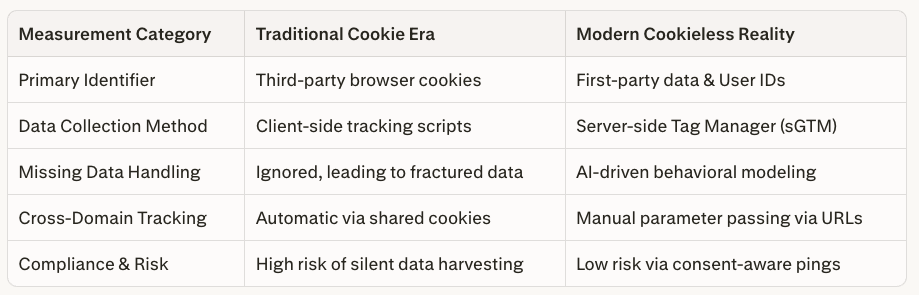
The hard truth: No analytics setup will ever give you perfect, deterministic cross-device attribution for every single user in a privacy-first world.
FAQ
Understanding the technical nuances of GA4 cookieless measurement is essential for maintaining a reliable system of record.
What exactly is a cookieless ping in GA4?
When a user denies consent for analytics cookies, Consent Mode v2 prevents the storage of traditional identifiers in the browser. Instead, it sends an anonymized ping containing non-identifying information like the timestamp, user agent, and page URL. This allows GA4 to register that an event occurred without knowing exactly who performed it, enabling behavioral modeling to estimate overall traffic patterns.
How does behavioral and conversion modeling fill the data gaps?
GA4 constantly analyzes the behavior of users who do accept cookies and applies those observed patterns to the anonymized pings of users who declined them. By using advanced machine learning, the analytics platform can accurately estimate metrics like daily active users, conversion rates, and campaign performance without violating privacy constraints.
Do we strictly need a server-side setup to do cookieless tracking?
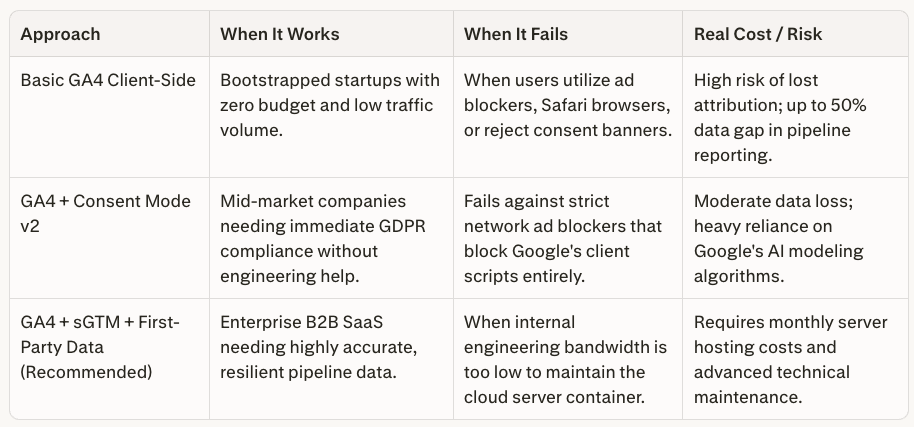
While basic Consent Mode can operate entirely client-side, using Server-Side Google Tag Manager is highly recommended for B2B SaaS. Server-side tagging runs securely on your own domain, preventing ad blockers from intercepting the data stream and giving you complete control over what information is sent to third-party platforms.
How does cookieless tracking impact our Google Ads performance and ROAS?
If you lose conversion data due to cookie blocking, Google Ads bidding algorithms cannot optimize effectively and ad spend becomes highly inefficient. Implementing Consent Mode v2 and server-side tracking ensures that critical conversion signals are fed back into the ad platform, maintaining your Return on Ad Spend and keeping acquisition costs stable.
What is the role of first-party data in this new privacy-first ecosystem?
First-party data—information you collect directly from your users, such as email addresses, CRM records, and authenticated User IDs—becomes the absolute gold standard for attribution. By heavily relying on first-party data and offline conversion imports, B2B companies can accurately track long sales cycles independently of browser-level tracking restrictions