
Agentic AI in B2B SaaS Marketing: What CMOs Need to Know in 2026

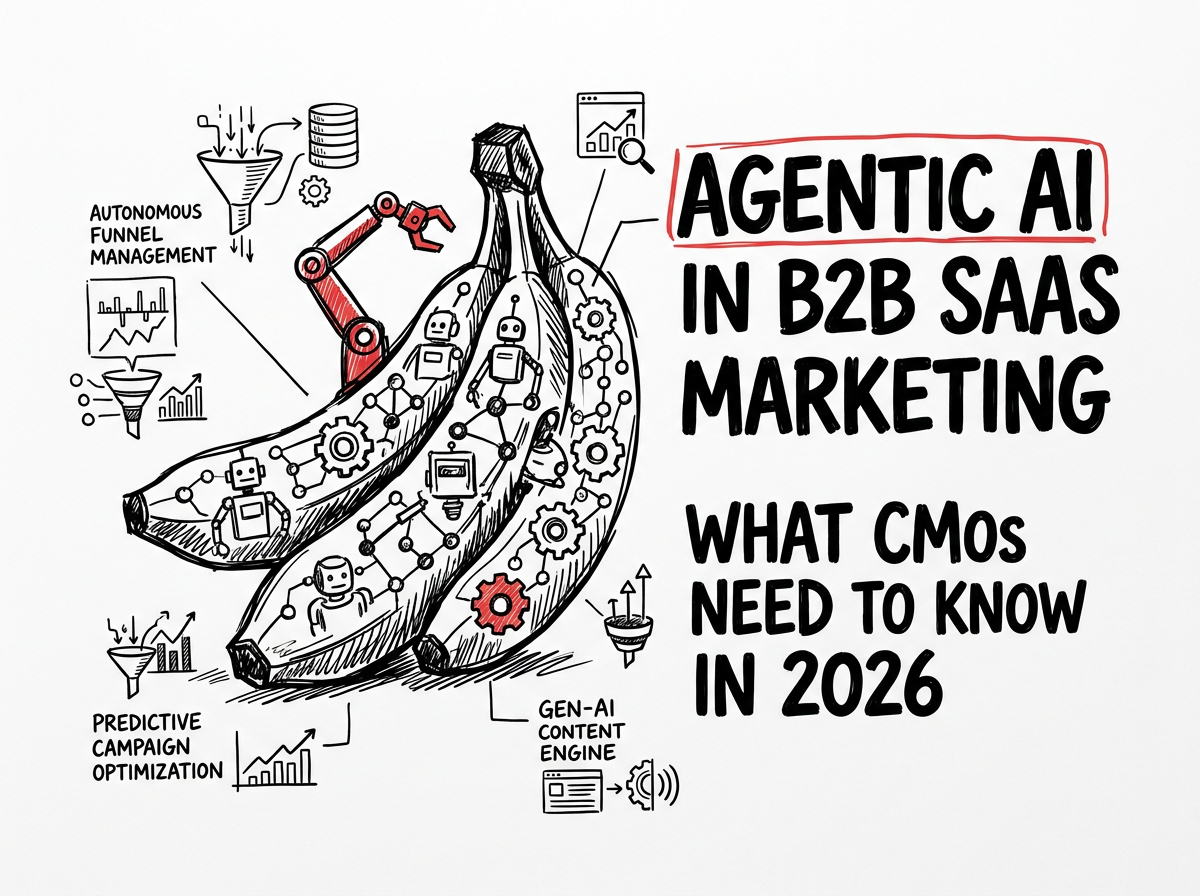
Agentic AI in B2B SaaS marketing means autonomous AI systems — SEO agents, content agents, personalization agents, lead-nurturing agents — that plan, execute, and optimize full-funnel campaigns without waiting for human instruction at each step. Unlike generative AI copilots that assist with tasks, agentic systems act: they retrieve live data, make decisions, call APIs, trigger workflows, and iterate on results continuously. For CMOs in 2026, this is not a technology upgrade — it is a structural redesign of the marketing function, and the companies that move first are projected to capture 5–10× ROI advantage over those that don't.
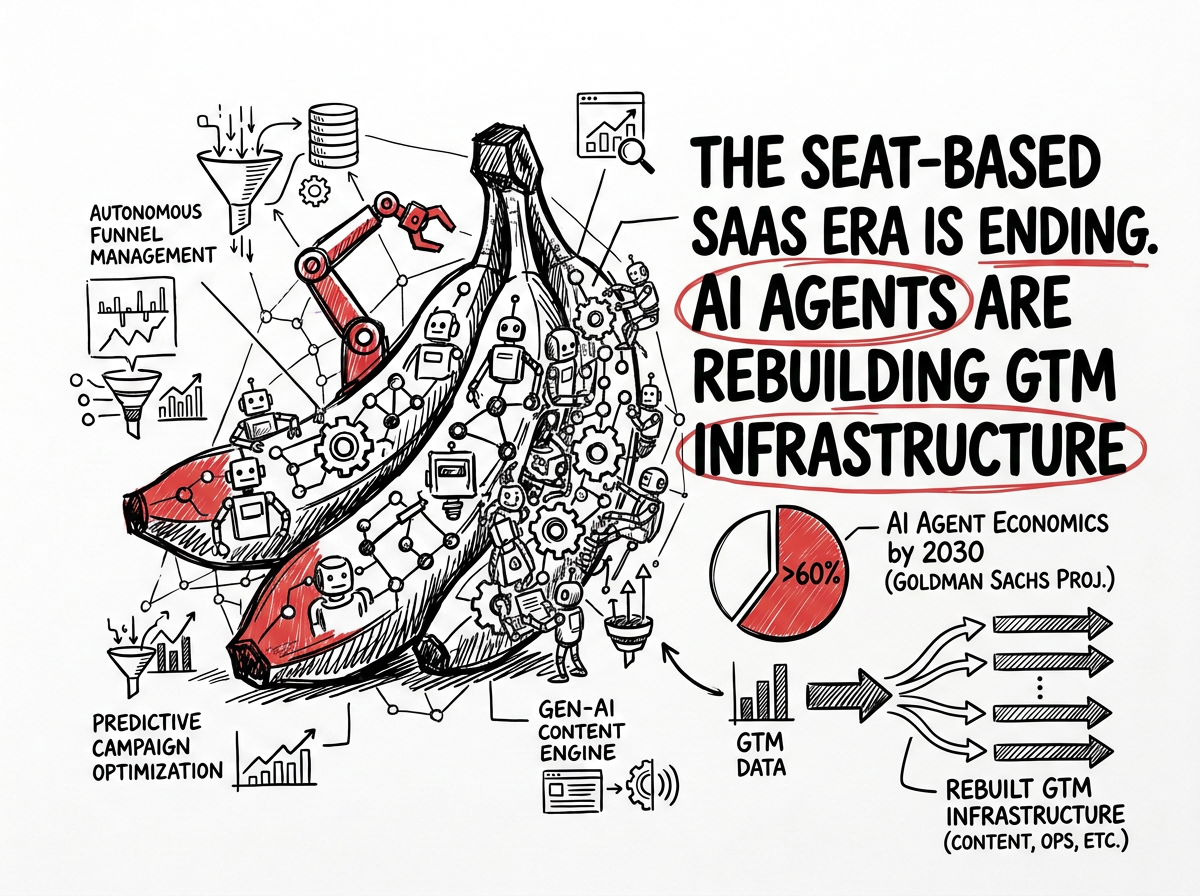
The seat-based SaaS era is ending. Goldman Sachs projects AI agents will account for more than 60% of software economics by 2030 — and the CMOs who understand this shift are not just adopting new tools, they are rebuilding their go-to-market infrastructure before the window closes.
Why This Matters Now (Strategic Context)
In February 2026, the software industry lost approximately $2 trillion in market capitalization as investors repriced the future of legacy SaaS. Salesforce, Adobe, and Atlassian stocks dropped as analysts modeled "seat compression" — the phenomenon where a single AI agent performs work previously requiring dozens of human licenses, eliminating the per-seat revenue equation that powered SaaS for two decades.
The phrase "SaaSpocalypse" is not hyperbole on X; it is analysts, operators, and founders describing a structural transition they can measure in real time.
The crisis: marketing tech stacks built on seat-licensed platforms face repricing, consolidation, and disruption.
The opportunity: autonomous marketing agent squads can execute what previously required teams of 15–20 — content research, SEO auditing, lead nurturing, campaign optimization — running 24/7 with compounding performance improvements. BCG's 2025 research found that agentic AI can triple marketing ROI, speed, and volume, translating to 5–10% incremental top-line growth and 15–20% cost efficiencies across internal and agency spend.
The 2026 inflection is structural: Deloitte projects 75% of companies will invest in agentic AI by end of 2026, with B2B SaaS being the fastest-adopting vertical. CMOs who treat this as a 2027 decision are already 12 months behind the curve.
Key Data and Market Reality
This is a summary of market insights and data around the web useful to understand the scenario and context where we're living right now.
- >60% of software economics will shift from SaaS seats to agentic workloads by 2030 — Goldman Sachs Research (2025/2026)
- $2 trillion in market cap erased from the software sector in early 2026 as seat-compression from AI agents repriced legacy SaaS valuations (Digital Applied / Chronicle Journal, February 2026)
- 5–10% incremental top-line growth and 15–20% cost efficiency across marketing spend achievable from agentic AI deployment — BCG, November 2025
- 171% average enterprise ROI projected from agentic AI deployments; 74% of executives achieving positive ROI within the first year (Digital Applied, February 2026)
- 30–60% reduction in manual marketing tasks and 15–35% increase in conversion rates from AI-optimized campaigns and personalization (Digital Applied, 2026)
- 22–69% ROAS improvement in AI-managed programmatic advertising case studies (Digital Applied, 2026)
- 75% of companies expected to invest in agentic AI by end of 2026 — Deloitte 2026 Technology Predictions (Zigment, December 2025)
- The agentic AI market is projected to exceed $10.9 billion in 2026 (Averi.ai, February 2026)
- 28% of B2B marketers are actively experimenting with agentic AI; 43% classify themselves as "pacesetters" — Content Marketing Institute (Bayleaf Digital, December 2025)
What Is Agentic AI, and How Is It Different from Generative AI?
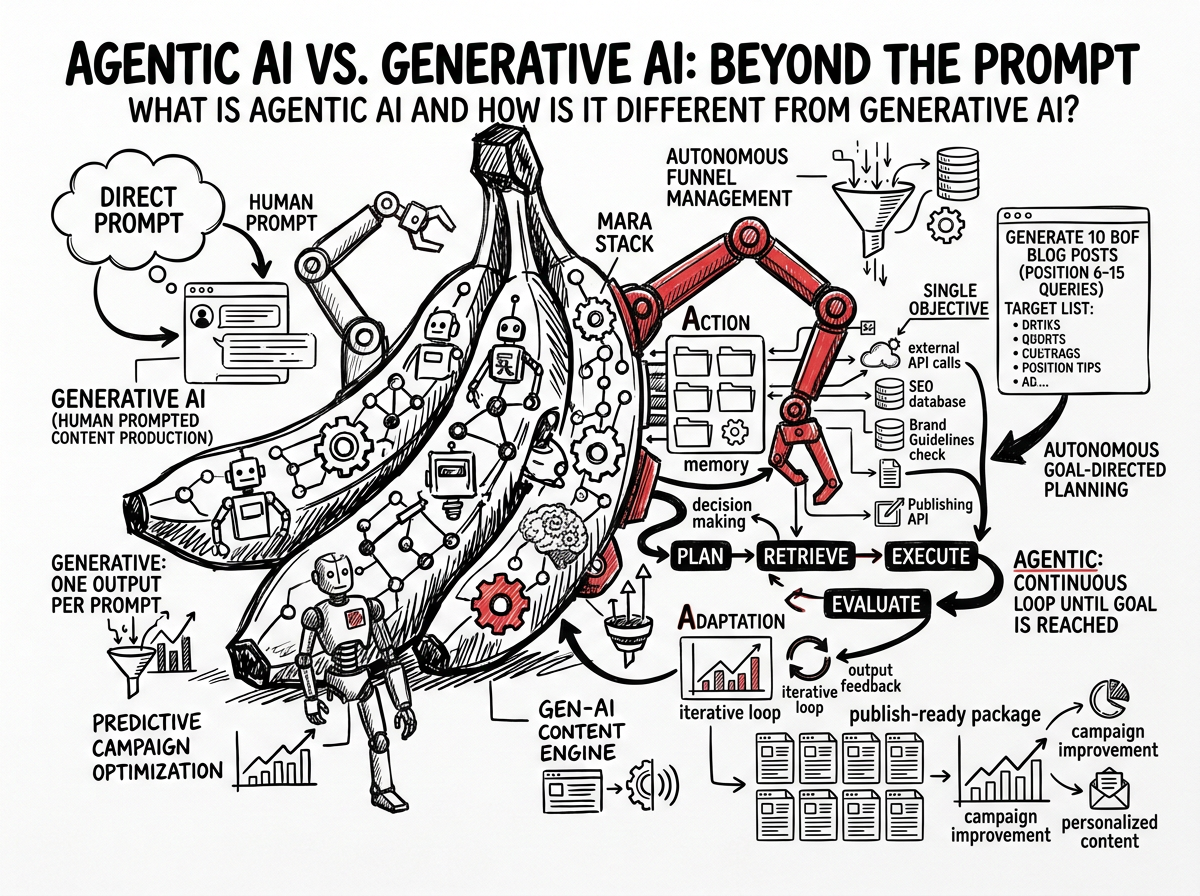
Generative AI produces content when a human prompts it
Agentic AI acts on goals. An AI agent receives an objective — "generate 10 bottom-of-funnel blog posts targeting these 10 GSC queries where we rank position 6–15" — and autonomously plans the steps, executes the research, writes the drafts, checks them against brand guidelines, and outputs a publish-ready package, without a human managing each step in sequence.
The critical technical distinction is the MARA stack: Memory (retaining context across tasks), Action (calling external APIs and tools), Reasoning (deciding which step comes next), and Adaptation (updating its approach based on output quality and feedback). Where a generative AI chatbot produces one output per prompt, an agentic system operates a continuous loop: plan → retrieve → execute → evaluate → iterate — until the goal is reached.
For B2B SaaS marketing specifically, agentic AI means campaigns that improve continuously as they run, content that is created and distributed faster than any human team can review, and personalization that adapts to individual buyer behavior at query time — not at segment-level approximation.
The SaaSpocalypse: What CMOs Must Understand About the Revenue Model Collapse
The SaaSpocalypse is not a metaphor. It is a repricing event driven by a single equation: if one AI agent does the work of five human operators, five seats become one API call. The per-seat model — the revenue engine of Salesforce, HubSpot, Adobe, Atlassian, and every other enterprise SaaS vendor — depends on headcount growth driving license growth. AI agents break this correlation permanently.

For CMOs, this has three direct implications:
- Your marketing tech stack will be repriced. Vendors whose value lived in giving humans interfaces — CRMs, CMS platforms, social schedulers, analytics dashboards — are under existential pressure to shift from seat-based to outcome-based pricing. Budget assumptions for 2027 and beyond must account for vendor consolidation, pricing model pivots, and the emergence of "headless SaaS" platforms designed for agent-to-API consumption with no human UI at all.
- Your agency and freelancer budget is being repurposed. The viral post format on X — "give SaaS away free as a lead magnet, then upsell managed AI agent services that eat labor budgets" — captures exactly where B2B SaaS vendor strategy is headed. Marketing agencies that survive will be selling orchestrated agent services, not headcount hours. CMOs need to evaluate agency relationships through this lens now, before contracts renew.
- You are now competing against teams using 10× leverage. A competitor CMO running a five-agent marketing squad — researcher, writer, SEO auditor, personalization agent, analytics agent — executing full-funnel campaigns 24/7 is not operating at your speed. They are compounding while you are planning. The performance gap widens every week that passes.
The CMO's Agentic Marketing Squad: 5 Core Agents to Deploy
BCG describes the agentic marketing transformation as moving from "human team with AI tools" to "AI agent squad with human strategic direction." Here is the practical architecture for a CMO-level agent squad in 2026:
Agent 1: The SEO and Content Intelligence Agent
Function: Continuously monitors GSC performance data, identifies zero-click opportunity pages (high impressions, low CTR, position 5–15), pulls competing content from SERPs, and generates structured briefs — with question-format H2s, direct-answer intros, FAQ recommendations, and comparison tables — for every page that needs optimization.
Output: Weekly prioritized optimization queue with specific recommendations per page, grounded in live search data. No analyst required.
Real-world result: Marketing teams running content agent loops report cutting content brief production time from 3–5 hours per page to under 20 minutes, with consistency improvements across the entire content team.
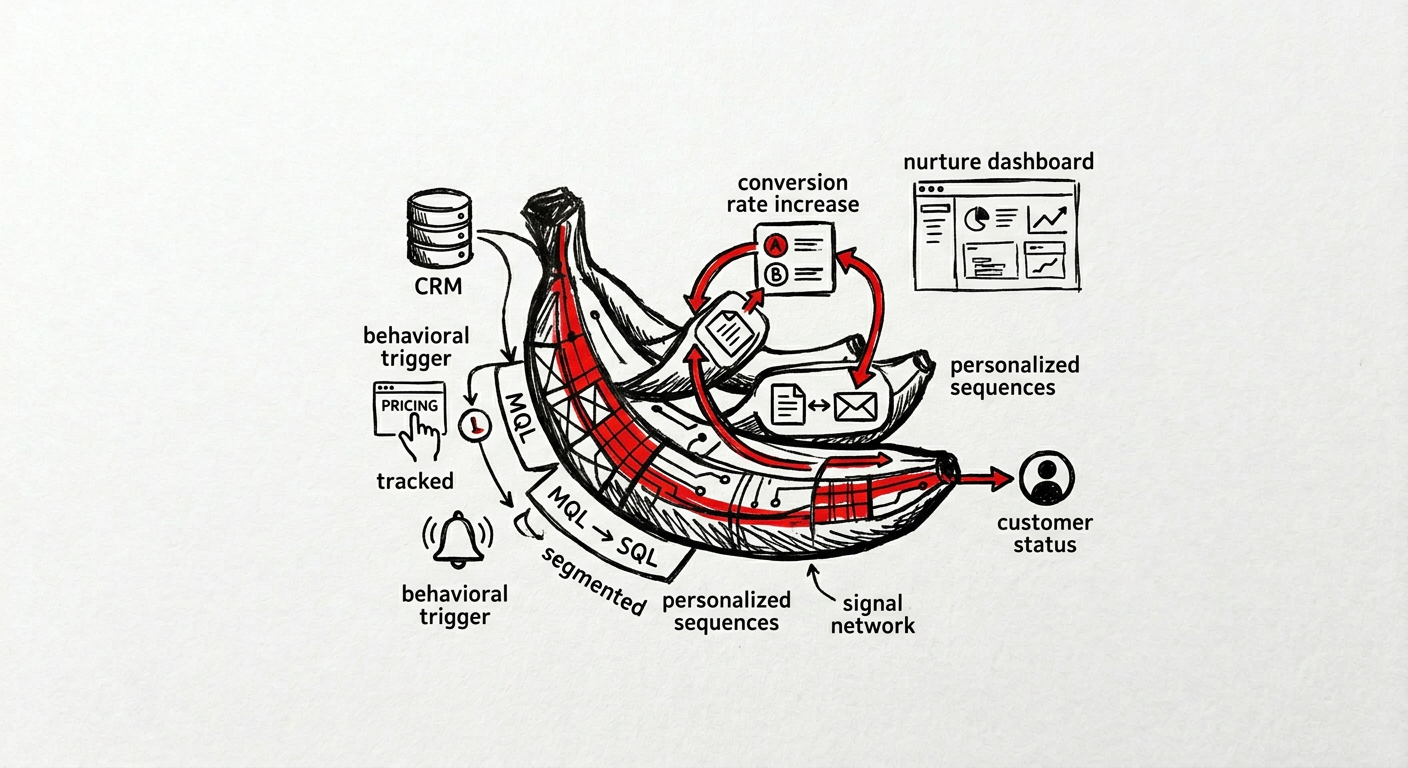
Agent 2: The Demand Generation and Lead Nurturing Agent
Function: Monitors lead behavior signals from CRM and marketing automation, segments leads by intent stage, generates personalized nurture sequences, triggers outbound touchpoints based on behavioral triggers (pricing page visit + 3-day silence = high-intent sequence), and updates sequences based on engagement data.
Output: continuously optimized nurture flows that adapt in real time. A/B test results are automatically incorporated without a human reviewing the dashboard.
Real-world result: organizations implementing AI-automated lead generation report 20–40% improvement in lead generation within six months, with conversion rate improvements of 15–35% from AI-personalized campaign flows.
Agent 3: The Competitive Intelligence Agent
Function: monitors competitor domains for content publishing, product updates, pricing changes, G2/Capterra review trends, and share-of-voice movements in AI search results (Perplexity, ChatGPT, Google AI Overview). Generates weekly competitive briefs and flags battle card updates needed for Sales.
Output: always-current competitive intelligence that previously required a dedicated analyst — now delivered as a structured weekly summary with action items flagged by urgency.
Agent 4: The Personalization and ABM Agent
Function: Connects CRM account data, firmographic enrichment, and behavioral telemetry to generate account-specific landing page variants, personalized email sequences, and dynamic content for target accounts. For ABM: generates individual executive briefings for target accounts before Sales outreach.
Output: True 1:1 personalization at the account and persona level — previously feasible only for tier-1 named accounts. Agentic systems extend this treatment to the entire addressable market simultaneously.
Agent 5: The Campaign Analytics and Attribution Agent
Function: Continuously ingests performance data across channels — paid, organic, email, in-product — and generates attribution models, anomaly alerts, and optimization recommendations. When a campaign underperforms, the agent identifies the failure point (creative, audience, timing, landing page) and generates a specific remediation recommendation, not just a data table.
Output: Replaces 80% of manual reporting work with actionable, causal analysis. CMOs receive a weekly "what changed and why" narrative rather than a dashboard to interpret.
The 3 Prerequisites CMOs Must Have Before Deploying Agents
This is the section most agentic AI content skips. Agents amplify what exists. They do not fix broken foundations.
Prerequisite 1: Data Readiness
Agents fail on bad data. An SEO agent working from an incomplete GSC export misidentifies opportunities. A nurture agent working from a CRM with duplicate contacts sends redundant sequences. A personalization agent without accurate firmographic data produces generic outputs dressed in a personalized wrapper.
Before any agent deployment, CMOs must audit:
- CRM data quality: completeness of company, role, intent stage, and behavioral fields
- GSC and analytics data: is tracking consistent across all pages and events?
- Content metadata: are your existing pages tagged with topic cluster, funnel stage, buyer persona, and publish date?
- Knowledge base structure: are product documentation, case studies, and battle cards in retrievable, machine-readable formats?
The Andrew Ng framing circulating on X is correct and blunt: "Break your data silos, control your data, or your agents will fail." Data governance is not an IT project. It is the CMO's most important prerequisite for 2026.
AI agents are getting better at looking at different types of data in businesses to spot patterns and create value. This is making data silos increasingly painful. This is why I increasingly try to select software that lets me control my own data, so I can make it available to my…
— Andrew Ng (@AndrewYNg) November 6, 2025
Prerequisite 2: Agent Optimization for Online (AOO)
In 2026, AI agents — ChatGPT, Perplexity, Google AI Overview, Claude — are increasingly the first interface between your buyers and your brand. The buyer's agent is researching your product before the buyer ever visits your website. If your content is not structured for machine extraction, you do not exist in AI-assisted research.
AOO (Agent Optimization for Online) is the practice of structuring content so AI agents can retrieve, extract, and recommend it accurately. The principles:
- Direct-answer blocks in the first 60 words of every section
- Question-format H2 headers that match natural language query patterns
- Schema markup (FAQ, Product, HowTo, Organization) on every key page
- Structured data in metadata: clear author attribution, publish date, topic category, and source citations
- Capability-level specificity: not just "we do X" but "we do X for Y use case, delivering Z outcome, measurable by this metric"
Gartner projects search engine volume will drop 25% by 2026 as buyers migrate to AI-powered agents. CMOs optimizing only for Google are optimizing for a shrinking channel. AOO is the parallel infrastructure investment that ensures visibility in the channel that is growing.
Prerequisite 3: Outcome-Based Budget Architecture
The shift from seat-based to outcome-based pricing is not just a vendor story — it is a budget story. CMOs running legacy "tool subscription" budgets — paying per seat for tools that will be replaced by or converted into agent services — are misallocating capital.
The new budget framework: allocate against outcomes, not tools. Budget lines should map to outcomes (qualified pipeline generated, content published and ranking, support tickets deflected, retention rate maintained) and the agent infrastructure that produces them — not the SaaS licenses that once housed those capabilities.
Gartner projected 40% of enterprise SaaS would incorporate outcome-based pricing elements by 2026. CMOs who rebuild their vendor evaluation criteria around outcome pricing — not feature sets — will be better positioned for the contracts they sign in 2027 and beyond.
Agentic AI vs. Traditional Marketing Automation vs. Generative AI Copilots
| Dimension | Traditional Automation | Generative AI Copilot | Agentic AI |
|---|---|---|---|
| Operating mode | Rule-triggered sequences | Responds to human prompts | Autonomous goal-directed execution |
| Campaign setup time | Weeks (human-built workflows) | Hours (human-guided drafts) | Minutes to hours (agent-planned) |
| Personalization depth | Segment-level (rule-based) | Prompt-level (per session) | Individual-level (memory + live data) |
| Self-optimization | None — rules are static | None — each prompt is independent | Continuous — agents iterate on output quality |
| Human involvement | High (setup, monitoring, iteration) | High (prompt per output) | Low — strategic direction + exception handling |
| Data dependency | Structured behavioral triggers only | Prompt context only | Full data stack: CRM + behavioral + live retrieval |
| ROI timeline | 6–18 months (workflow maturity) | Immediate (task by task) | 30–90 days (compounding improves over time) |
| Scale ceiling | Linear — scales with team size | Linear — scales with prompts | Exponential — agents run in parallel, 24/7 |
| Risk profile | Predictable — deterministic | Low autonomy, low risk | Higher autonomy — requires governance framework |
| 2026 competitive leverage | Table stakes | Narrowing advantage | Primary differentiator |
Trade-offs and Limitations
| Approach | When It Works | When It Fails | Real Cost / Risk |
|---|---|---|---|
| Traditional marketing automation | Predictable, rule-based nurture for high-volume, low-complexity segments | Complex buyer journeys, dynamic product changes, real-time personalization needs | Declining ROI as buyer behavior outpaces rule updates; legacy tech debt |
| Generative AI copilot (no agents) | Accelerating individual task output; small teams without engineering capacity | Consistency at scale; continuous campaign execution; compounding optimization | Productivity gain is linear, not exponential; advantage disappears as all competitors adopt |
| Single-agent deployment | Targeted automation of one high-cost workflow (RFP responses, SEO briefs, reporting) | Full-funnel campaigns; cross-functional coordination; complex multi-step reasoning | Underutilization of agentic infrastructure investment; siloed improvements |
| Multi-agent squad (Recommended) | Full-funnel autonomous campaign execution; compounding cross-agent feedback loops; scale without headcount growth | Poorly structured data; unclear goal definition; no human governance layer | Requires upfront data readiness investment and governance design — skipping this is the most common failure mode |
Real-World Applied Scenario
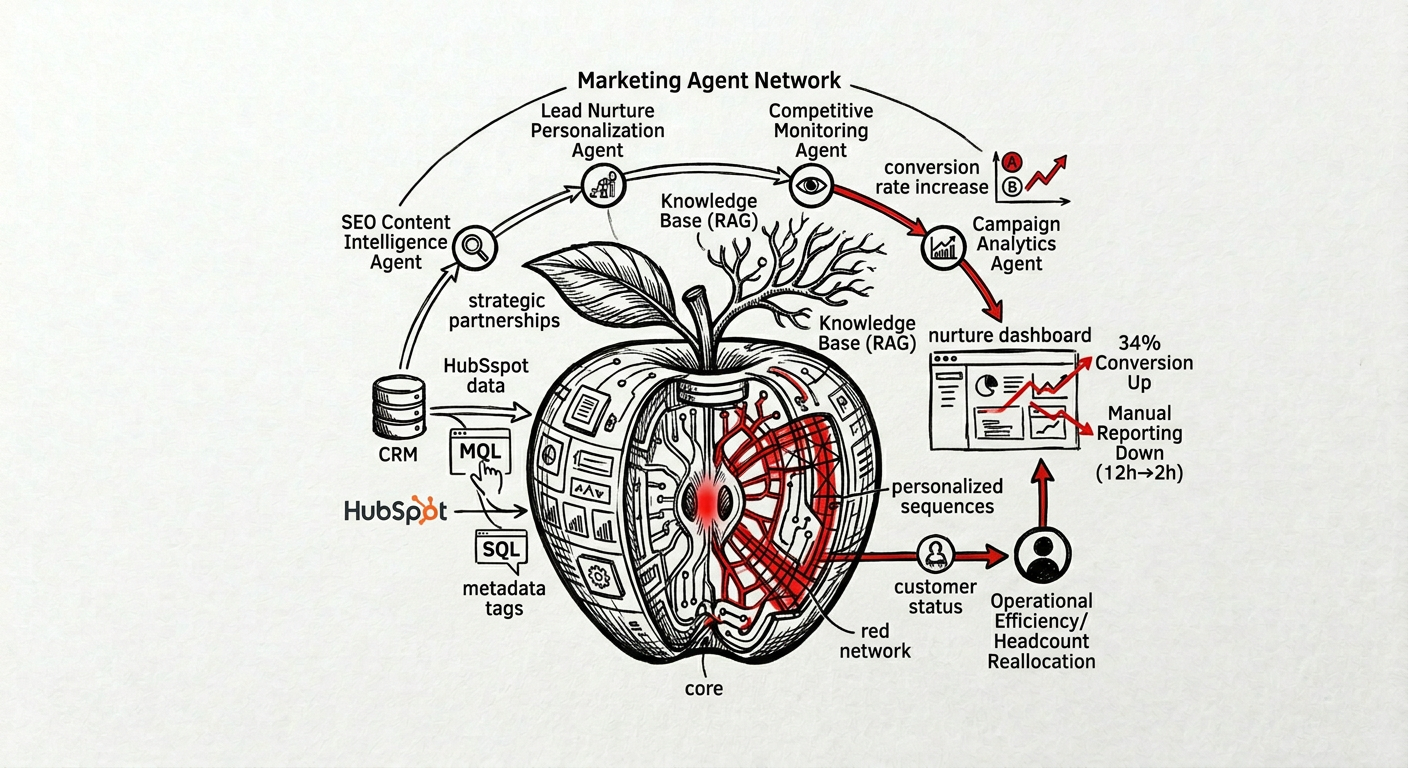
A B2B SaaS company in the marketing intelligence space (mid-market, 120-person team, CMO-led marketing function of 12) deployed a four-agent marketing squad in Q4 2025: an SEO content intelligence agent, a lead nurture personalization agent, a competitive monitoring agent, and a campaign analytics agent.
The deployment timeline was 90 days. The first 30 days were spent on data readiness: cleaning GSC data, tagging 340 existing content pages with structured metadata, resolving CRM duplicate contacts (found 22% duplication), and building a RAG-indexed knowledge base of case studies, battle cards, and product documentation. No agents were deployed in this phase — this was the prerequisite investment the team had previously skipped.
Days 31–60: SEO and analytics agents were deployed first, connecting to GSC and HubSpot. The SEO agent identified 47 pages with > 500 impressions and 0 clicks (position 5–15) and generated structured optimization briefs for each. The analytics agent replaced the weekly manual reporting process, delivering causal narratives instead of data tables.
Days 61–90: Nurture personalization agent deployed across all active deal stages in HubSpot. Competitive intelligence agent began producing weekly briefs for Sales.
Outcomes at 6 months: organic impressions-to-click conversion rate improved 34% on the 47 optimized pages. Lead-to-opportunity conversion improved 19% on agent-personalized nurture sequences. Marketing team time spent on manual reporting dropped from 12 hours/week to under 2 hours/week. The CMO reallocated two headcount from operational marketing to strategic brand and partnerships work — the team stayed the same size but operated at materially higher leverage.
"Agentic AI does not replace your marketing team. It removes the work that was preventing your marketing team from doing the work that only humans can do."
FAQ
What is agentic AI in B2B SaaS marketing, explained plainly?
Agentic AI in marketing means autonomous AI systems that receive a goal — generate pipeline, improve content performance, monitor competitors — and execute all the required steps independently, without a human managing each action. They retrieve data, make decisions, call tools and APIs, produce outputs, evaluate quality, and iterate. The distinction from a generative AI tool: you give an agent an objective, not a prompt. The agent figures out the plan and executes it continuously.
How is agentic AI different from what we're already doing with AI in marketing?
Most marketing teams today use generative AI as a copilot: a human prompts, the AI produces one output, the human edits, publishes, and moves on. Agentic AI removes the human from the middle of every step. A content agent does not produce one blog post when asked — it monitors your GSC data, identifies underperforming pages, generates optimized briefs, writes drafts, checks them against brand guidelines, and queues them for publication, continuously, without daily direction. The performance gap between a copilot user and an agent operator compounds weekly.
What is the SaaSpocalypse and why should CMOs care?
The SaaSpocalypse is the name analysts and investors gave to the February 2026 software sector repricing event, where legacy SaaS companies lost approximately $2 trillion in market cap as AI agents threatened the per-seat revenue model. For CMOs, the practical implication is a double signal: your marketing tech vendors are under pressure to pivot their pricing and architecture (expect disruption in your stack), and your competitors who adopt agent-based marketing infrastructure first will operate at a leverage advantage that compounds over time. Both signals require a response in 2026, not 2027.
What does "data readiness" actually mean for a CMO deploying agents?
It means your data is complete, consistent, and structured enough for an AI agent to retrieve and reason on it without hallucinating or producing garbage outputs. Specifically: your CRM has complete company, role, intent stage, and behavioral fields for the majority of contacts; your analytics tracking fires consistently across all pages and events; your content is tagged with topic cluster, funnel stage, and buyer persona metadata; and your knowledge assets (case studies, battle cards, product docs) are in machine-readable formats with clean structure. If you deploy agents on dirty data, the agents are not wrong — they are accurately executing against the mess you gave them.
What is Agent Optimization for Online (AOO) and how is it different from SEO?
AOO (sometimes called AEO — Answer Engine Optimization — or GEO — Generative Engine Optimization) is the practice of structuring your content so AI agents can retrieve, extract, and recommend it accurately when a buyer's AI assistant is researching your category. Traditional SEO optimizes for human-clicked Google rankings. AOO optimizes for machine-readable extraction: direct-answer blocks in the first 60 words of each section, question-format headers, structured schema markup, and specificity of claims (not "we increase revenue" but "customers report an average 23% increase in pipeline velocity within 90 days"). In 2026, your buyers' AI agents are doing the research before the buyers visit your website. AOO determines whether you exist in that research.
What is the new revenue model for B2B SaaS in an agentic world?
The shift is from seat-based access pricing (pay per user per month) to outcome-based agent pricing (pay per task completed, revenue influenced, ticket resolved, or FTE hour replaced). Goldman Sachs projects this shift accounts for 60%+ of software economics by 2030. For CMOs, this means vendor contracts will increasingly be structured around outcomes — and your internal budget architecture should mirror this shift. Build budget lines against outcomes (qualified pipeline, content published and ranking, retention rate), not against tool licenses.
How do we prevent agents from going off-brand or producing errors at scale?
The answer is governance architecture, not model selection. Production-grade marketing agent squads include: a critic or reviewer agent that checks outputs against brand guidelines before they exit the system; human-in-the-loop checkpoints for high-stakes outputs (executive communications, legal-touching content, pricing claims); source-grounded generation (RAG architecture ensures agents cite retrievable documents, not hallucinated facts); and anomaly monitoring that flags performance deviations. Fully autonomous agents without governance create brand risk at scale. The winning architecture in 2026 is agents that handle execution, humans that define objectives and approve exceptions.